Saturday, February 15, 2014

Helena speaks for the trees: The Lorax

Over the last three weeks, as I have been lain flat on my back by an attack on my sciatic nerve, Helena has watched, read, and acted out The Lorax at least a hundred times.  Though I had read her the book before, this extraordinary attack of repetition began when she saw the 2012 version, made by the same people who did Dispicable Me, but has reached on to include the early 1970s film broadcast on TV, two editions of the Dr. Seuss classic, the spanish version, an improvised Portuguese version (Helena has insisted that Rita translate the book), and numerous games in playgrounds, at home, and in the woods above Santa Fe.  As you might guess, I have had quite a bit of opportunity to compare different variations on the story -- almost as much as a Biblical text critic looking at 17 versions of the Gospel of John in different greek monasteries -- and I have come to a rather unexpected conclusion: the highly commercial, computer-driven 2012 version is the best of all of them.  Yes, even better than Dr. Seuss's book.


No knocks to Dr. Seuss here: The Lorax was one of my favorite books when I was a kid, Rita bought it for me to read to Helena before our little girl was even born, and I had memorized most of it even before Helena got into this Lorax craze.  The movie, however, manages to be even more politically radical -- and at the same time more hopeful -- than the book.  Helena has been right to fall in love with it.

A book -- especially a poetry book -- can be a fable, but a movie can't really get away with that.  The characters need back stories, clear motivations, a framework for identification and catharsis.  The movie gives as the Once-ler as a young man, naïve and hopeful that he will change the world with his Thneed.  He's not the faceless evil of the book, but a sympathetic guy, a little clueless, but a portrait of young America at its best.  After cutting down the first truffula tree, he comes to see that the Bar-ba-loots and the Swammy Swans and the Humming fish all depend on the forest; he agrees not to cut any more trees.  He and the Lorax chat, dine, and play cards together: they become friends.  Before he is a success, we identify with the Once-ler, we like his music and his innocence.

Evil doesn't come from inside the Once-Ler, but from a nasty one-two punch: the demands of the market and the weakness of his family.  After failing to sell even one Thneed for days, the Once-ler throws it away in frustration... only for it to land on the head of a cute teenager.  Everyone confounds the Thneed for a fashionable hat, and the floodgates are loosed.  Hundreds of people march on the forest, each demanding a Thneed.  Second, when the Once-ler calls his family to help him produce Thneeds in the factory, we see his weakness: as he had left home, his mother said, "Now if you don't succeed, dear... then it's just what we expected!"  As she, his father, aunt, and the rest of the family arrive on the scene, we see how much he wants their approval and love.  When his father points out that to increase production they need to cut down the trees instead of just gathering the tufts, we can see the internal debate on the young Once-ler's face.  Finally, his need for family approval overcomes his promise to the Lorax, and he says, "Well, cutting down just a few trees can't hurt..."

This expansion of the story is much more honest to how evil comes about in late capitalism.  It isn't just, as the Lorax puts it, that the Once-ler is "crazy with greed," but that he is weak.  The market wants Threeds.  His family wants success.  He is flattered by their desires for him, for their ideas that he can fulfill what they want.  The Once-ler accepts the desires of other people as his own desire, even though they will not make him happy, either.  If we look at Google in China, Nike in Indonesia, Apple and Foxxcom... the backstory of the Once-ler explains that kind of banal evil much more than the simplicity of greed or malice.

Helena at the Wildlife Conservancy Preserve outside of Santa Fe.
A return to the innocent days of the Once-ler also explains his final act, keeping the last of the Truffula seeds and giving it to the boy (unnamed in the book, named Ted in the movie as a tribute to Ted Geisel, Dr. Seuss's given name).  Wracked with guilt, the Once-ler is himself unable to do anything to right his wrong, but Ted gives him the opportunity at redemption.  The Once-ler is not a bad person, but a person who has done many bad things, and has become a prisoner of that history (symbolized by the slats he nails to his window so that no-one can see him... and so that he cannot get out.

The movie also gives us a backstory for the boy who goes to the far end of town where the grickle-grass grows.  He's a young teenager in love, and the girl wants to see a tree.  For a Brazilian, the story reminds us of the strategy of the Brazilian Communist Party, which worked to recruit the best looking young women, who would in turn inspire men to join... but it also rings true.  As the Once-ler remarks to Ted, "If a guy does something stupid once, it is because he is a guy.  But if he does it two times, there is sure to be a girl in the story."

Ted, like the Once-ler, is living someone else's dream... but he soon takes it on as his own.  He comes to care about trees, to long for nature and clean air.  He soon brings in Audrey (the cute girl; her name is probably a tip of the hat to Seuss's second wife) as an ally, and not only as an object of desire.  In this way, the film recognizes that just as the motivations of those who do evil are not always evil, the motivations of those who do good are not always pure.

In my next post, the subversive critique of Thneedville...

Saturday, January 18, 2014

Fearing the woods: Daniel Tiger's Neighborhood

Mr. Rogers, that wonderful cardigan-wearing MC of my childhood, died several years ago, but his legacy lives on for Helena's generation through my favorite character from the Land of Make Believe, Daniel Striped Tiger.  For those of you without 3 year olds to keep you up to date, Daniel now has his own animated show, full of the same elements that Mr. Rogers used to such good effect: the trolly, a crazy cast of caring (and of course multicultural-multiracial-multispecies) characters, and lots of catchy music.  Helena loves it and I confess that I like the fact that we get to sing "It's a beautiful day in the Neighborhood" together as we drive to swimming lessons in the morning.

Unlike many movies about solitary kids looking for family, Daniel already has a family, and a very good one.  Reminiscent of my own, in fact, with a caring mother who has a solution to any problem Daniel faces, a Dad who loves to play, a grandpa who shows up to Daniel's great expectations.  (Since the program is a conscious attempt to revive a show from my childhood, it isn't unusual that I should see my own childhood hidden in it, I guess...)  In that way, and in its focus on the quotidian events of a child's life, it is an interesting counter-example to the movies about orphans I used to talk about American individualism last post.  I confess I find it a little slow, but Helena loves the valorization of day to day life, and the way that the loving relationships seem to reflect something in her own dreams of family life.

Without the adventures and extra-quotidian elements that fuel Disney and Pixar movies, Daniel Tiger's Neighborhood needs something else to drive the plot, and it uses the anxiety of childhood: worry about going to the doctor, concern about being liked at school, fights between friends...  These "tiny" things play a huge role in a child's life and imagination, and I certainly remember how the fear of being teased, of going to the dentist, or of not finding friends in a new school brought about something close to trauma in my eight year old head.  It's important for Daniel's mother to sing "Before we do, something new, let's talk about what we'll do," or, when leaving Daniel at school, "Grownups come back."  (Helena has come to sing both of these little ditties, much to my consternation)  In spite of how boring it may seem to a grownup, this reassurance is important to little kids.

Here's the problem, though: not every kid suffers the same anxieties, but the show wants to touch on the fears of every kids in the audience.  In one episode, for instance, the friends are going to go for a walk and a pretend camping trip in the woods, and O the Owl is horribly frightened.  Much of the show is dedicated to showing that we fear things we don't understand, so when we are afraid, we should go and look more closely -- and thus find out that the shape that looks like a monster is the shadow of something innocuous.  A good message, both practically and socially, and one that even adults would do well to hear.

Helena isn't anxious about the woods, though.  In Brazil, she lives in the jungle.  Here in Santa Fe, some of her favorite times have been walking in the juniper and piñon forests in the foothills.  She doesn't need the message of reassurance... so what she picks up on is the fact of fear.  Just as Michel Foucault showed wonderfully how the prohibition of certain "offenses" actually creates the desire to do them, sometimes when a children's program wants to calm a fear that a child doesn't have, it actually draws attention to that fear, and may construct it out of thin air.  For a day after Helena watched the episode about camping and the woods, she wanted to "Play Daniel Tiger": she would be Owl, and I would be Daniel Tiger, calming her as we walked through the pretend woods of our loft.  Helena is a very good actress, so pretending to be scared turned quickly into being scared.  Since then, she has also shown more fear in real situations, like going down the "Big Scary Slide" (4 stories tall: it is big and scary) at the park, or putting her head underwater at swimming lessons.

Here's the interesting thing, though: one of Helena's favorite new games recently has been playing out the plots of her favorite movies.  It's not just Owl and Daniel Tiger in the woods: she tells me to be Baloo so she can be Mowgli and Rita can be Bagira (from The Jungle Book); or I am Sully and Rita is Mike Wazowski to her Boo (from Monsters Inc).  She works very hard to get inside the personality she is playing: feeling the fears, laughing at the same things that make the character laugh.  There is a negative part of this, one that I feel very quickly, as the fears of Owl or Boo (or the rebelliousness of Mowgli) start to filter out into Helena's real life.  But there is also a very positive part of the process: as she plays new roles, she starts to see the world through other eyes, to empathize with people (and animals) who live a very different life from hers.

Helena and her friend Jazmim, swimming in the Rio Negro (April, 2013)
According to Eduardo Viveiros de Castro, the great anthropologist of Amazonia, this shift in perspectives, seeing the world through the eyes of the other, is the fundamental goal of life for indigenous peoples in Lowland South America.
Thanks to our work, Helena has spent a lot of time with Amazonian Indian kids, but I don't think she learned this idea from them.  It's interesting that she gets it from watching the most mainstream of American children's films.  So in the end, though I may get frustrated at her new fears, I'm proud of the fact that she is learning to see the world through the eyes of many any diverse creatures.  Amazonian Perspectivism, and she still isn't even four years old...

Monday, January 13, 2014

Orphan monsters and kids' fears

For the last week or so, Helena Iara has been suffering from nightmares.  She wakes up screaming in the middle of the night, and in the morning, when she relaxes enough to talk about the night, she tells us that a monster has been chasing her.  I suppose that the experience is relatively normal, if disturbing to bother her and us, but the solution that she and Rita have developed is interesting: as they talked about the monster, the have invented a son for him.  The son is little and cute, will play with Helena... and then, as her friend, will intervene with the monster on her behalf.  Almost two years ago, when Helena was afraid of the Big Bad Wolf, inventing Lobinho (the little good wolf) served the same purpose; Lobinho is Helena's imaginary friend even today.

What does any of this have to do with media criticism for children?  Many children fear monsters, and some movies have addressed the issue very well: Monsters Inc, for instance, tries to show kids that "Monsters are people too," and if you get close enough to them, they turn out to be good and kind.  Helena's solution to the monster problem forced me to notice something, though: Sully and Mike Wazowski have no family.  Yes, in Monsters University we discover that Sully's father was a famous scarer, but we never see Sully with his family.  The most important relationships they have in the University are with other student and frat brothers; in Monsters Inc, their important relationships are with co-workers.

As we think about other children's movies, we see that most of the main characters are alone in the world.  In Annie or Despicable Me, the children are explicitly orphans.  In Up, Carl is a widower and Russell tormented by the lack of care by his absent father.  A Bug's Life, Shrek, At Home on the Range, Open Season... in all of these films, the most important relationships are those that the characters choose, not the ones that they have been given by birth.  Even as we look at more traditional movies, we see many, many children without families: Cinderella, Sleeping Beauty, Snow White, Pinocchio...  Clearly, this rule is not universal: Bambi and Dumbo involve close family relationships, and Finding Nemo is all about the attempt to reconstruct family (I could note, however, in all of these cases, that the protagonists are children of single parents).

Helena swings her cousin Fernando.
Bruno Bettleheim and other critics of fairy tales have reflected well on the fears of children, how they both desire independence and fear being alone, without mother and father.  Certainly, those issues play a role in the choice to make children's movies about orphans.  I wonder, though, if it doesn't also say something about American individualism.  Helena lives between two worlds, between the fragmented family of the American educated middle class, and the intense nuclear and extended family of Brazil.  For her, solutions are often familiar (in the etymological sense): the Big Bad Wolf and the nightmare monster are both redeemed by their children.

When I look at Helena's relationship with her extended family, this perspective makes sense: she has a dozen uncles and aunts who form an active part of her life; she loves playing with her many, many cousins.  Family is a resource and a pleasure.  I don't see that in American children I know: they may love their grandparents and get excited about an uncle's visit, but these events seem unusual, something out of the normal.  They are not going to save you from a monster.  And that break in the extended family has an impact in children's movies, and finds its way into the evil "mother" in Tangled and the solitude of the robots on Wall-E.  Though Helena has enjoyed watching those movies, from her perspective, there is something missing in them.

Sunday, January 5, 2014

Words that work: Winnie the Pooh

It's hardly unusual for Helena to like Winnie the Pooh: generations have fallen in love with the little stuffed bear and his motley collection of friends.  I certainly remember my father reading stories from the hundred-acre wood, and words like Heffalump and Woozle come back easily, even after all these years.


What I hadn't remember, though, is the materiality of the words in the stories.  Let me give an example from the 2011 Disney version of Winnie the Pooh: all of the major characters have fallen into a pit, and they can't find a way out.  After much despair and a couple of foolish mistakes (Piglet cuts the rope into six pieces, Tigger falls in dressed as a Backsoon monster...), suddenly the letters from the words on the page fall into the pit, and Pooh and Piglet use them to make a ladder to climb out of the hole.  The words read by the narrator cross the line between text and image, and become part of the story they were supposed to describe.

If we would see this kind of a literary device in a "serious novel" (say, by Italo Calvino or John Barth), and it would be lauded (or jeered) as postmodern metafiction, something bold and innovative (or precious and annoying).  In a kids' movie, on the other hand, it seems like a throw away joke.  Clever, perhaps, and even a bit funny, but hardly worthy of the dozens of doctoral dissertations in comparative literature on Borges and Milan Kundera that gather dust on academic bookshelves.

But here's the issue, whether in the scene with the words that serve as a ladder, or another, earlier in the movie, where Pooh walks along the lines of text across the book's page, only to find the letters falling out from under him (just think about that, you deconstructionist English majors out there!): Children, wizards, animist witch-doctors, and ordinary language philosophers like Wittgenstein and Austin all know that words are powerful things.  European modernism wants to make a rigid break between words (which signify) and things (which are signified), but the truth is that words are things, they are actions: they change the world.  As JL Austin says, when a priest or a judge declares "man and wife", the world itself changes.  These words don't mean anything; they do something.  The same is true for a wizard's spell or a voodoo priest's pins in a doll.  These words do things; they break down the simple division between things and words.

Winnie the Pooh, a commercial movie (by Disney, no less!), conveys this message in a way that's much more fun than the impenetrable prose of Derrida or Paul de Man.  Perhaps I don't remember the message from my own childhood (it is also present in the 1977 "The Many Adventures of Winnie the Pooh", which we just watched with Helena as well) because kids intuitively know that words have power, that they don't just describe.  We only go down that mistaken path after years of school.  As anyone who reads to pull himself out of depression knows, words do pull one out of the pit, they are a ladder to freedom.  Pooh can teach that just as well as Wittgenstein.

Tuesday, December 10, 2013

Myths, idolatry, escape: Shrek


Last week, I talked about how A Bug's Life and Monsters Inc tried to teach kids about ideology.  The criticism of the power of myth is even stronger in the Shrek movies, where everyone becomes imprisoned in the idea of what they “should be.”  The  power of “should be,” defined in Shrek like a fairy tale or legend, is what the thinkers in the Frankfurt School call “ideology.”

When the movie narrates the rescue of Princess Fiona, it illustrates well the power of myth in a person’s life.  Fiona’s parents locked her up in a huge tower, guarded by a ferocious dragon, knowing that only her “true love’s first kiss” will break her spell.   She spends her time in the tower practicing martial arts and in reality, is a very very strong woman.  Nonetheless, when a knight in shining armor arrives to rescue her, she passively situates herself on the bed, with a flower on her chest, just like the Sleeping Beauty.  After confirming that the unconscious Shrek is okay, she runs to her bed to create a scene out of a Disney moive from the 1950s.  For her, the rescue scene has to be perfect: when Shrek wakes her up, she says, “This should be a marvelous, romantic moment”.  If reality conflicts with this Should, it is the Should that is going to prevail.

Princess Fiona talks a lot about destiny, understood as the force that transforms the world
Helena, dressed as Snow White.
from what it is to what it should be.    She explains that her destiny is to kiss her first love, free herself of the spell and marry the Prince that kissed her.  This obession with destiny makes it so that she can’t exercise her own free will, that she always chooses “what should be” instead of what she wants.  It is the same for the ogre, Shrek;  he’s ready to abandon his love for Fiona because he believes that world doesn’t work in this way, that he “should” be stronger than his desire.    When the princess goes to the palace to get married to the horrible Farquaad, Shrek returns to his bog and with perverse enjoyment says, “This is how it has to be.”  To abandon his own free will and conform with the absolute power of Should, becomes a pleasure.

Shrek uses other words to reflect on Should, especially “myth” and “fairy tale”.    It is the people who believe in it who give myth its power.   “The whole world knows what happens when you find your true love,” says Fiona, waiting to lose herself in the eyes of a lover, the Prince Charming who will rescue her from everything evil.    Waiting for the love that “the whole world knows”, she remains blind in the face of true love and chooses to abandon Shrek for the ridiculous Lord.   Lord Farquaad rides a horse-way better than an ogre who walks alongside a donkey!-therefore, this “should be” true love.  

As such, it’s important to distinguish between ethics as it is and the Should.  The Should stems from what “the whole world thinks”, which in reality, is not really what everyone thinks, but what I think others believe in or hope for.    Just like the “they” from “you know what they say”, the Should ought to be an empty category; probably no real person says what “they” say since we all know what “they” say.  It’s possible that no human being really wants to marry a man like Lord Farquaad, but “the whole world knows” that a princess “should” marry a prince, that’s why Fiona did it.    Shrek intentionally creates confusion between fairy tales and Should, because the two teach us how to behave and what to expect from the world, but without much reflection.  The poor and oppressed girl “should” be rescued Prince Charming;  it doesn’t matter if she is stronger than any prince, she should always be the victim.  It doesn’t matter if she doesn’t love the prince, she should always love the prince.  This is how the myth is established.

The ethical, in contrast, stems from reasoning, reflection, and love.   It is a decison that I make in dialogue with tradition, with the world, and other people, and it isn’t something that I passively receive.    In many cases, the ethical is the exact opposite of the “Should”.   Boy and girls live in this cross between the ethical and the Should, which is why children’s movies also raise the issue.  

Lord Farquaad embodies the opposition beween the Should and the ethical.   What the “whole world wants”-at least in the world of the Should-is power and prestige.    Lord Farquaad doesn’t love Fiona, but he will marry her because it is part of the path that will allow him to be King.    Nonetheless, it isn’t really clear if he wants to be King.  The Should teaches him that he should be King.    He thinks that everyone else thinks he wants to be King.  Because he should want to, he does.     And dominated by the Should, the Lord has very little time to consider the ethical.  He will make many people suffer and sacrifice themselves—this means he will oppose the ethical—because the Should makes him do it.

In the first scenes of the movie, there is a social cleansing campaign against magical creatures, which follows the same logic.  Lord Farquaad wants a “perfect” world, where perfection is understood in terms of Should.  What "the whole world" wants is cleanliness and prosperity, order and progress, but the kingdom that Farhquad creates is not viable, it is a place where no one wants to live.  No one is around when Shrek and the donkey arrive at the castle.  In reality, for all its perfection, it is an intolerable place.  The scene reminds me of my first trip to Brasilia, an ultramodern city created to be the capital of Brasil.  The government buildings surround a grand quadrangle, with perfect geometric proportions, green grass, and complete cleanliness, and there isn’t anyone there.  No one.  Even the government employees escape to other cities on the weekend.  It is a city that should be perfect, the incarnation of what the whole world wants and is a place where no one wants to live.  

In the Shrek movies, the powerful myths have to do with love and power.  In other children’s movies, they also talk about money as a myth that imprisons people: in Robots, the bad guy is the head of Bigweld Industries, an executive who wants to kill all of the poor robots in order to increase his company’s value.  However, even his wickedness is ambiguous.  In reality, more than evil, he is insecure around his powerful mother and on several occassions it becomes apparent that he doesn’t even know what he wants.  He lacks a clear desire-and without a clear ethic—he easily falls prey to the enchantment of money.  He abandons good values—solidarity, creativity, affection—because “there is no profit in that,” but neither is it clear what he wants out of all of the money he gains from being evil.   Even among the worst people, it’s the Should that runs everything.

Liberation Theology made an important advance in the criticism of ideology, a critique that first that arose in Europe and the United States in between the wars.  For thinkers such as Juan Luis Segundo, Enrique Dussel, and Franz Hinkelammert, ideology has the structure like idolotry: meaning, to worship a false god.  Money has turned into our divinity, and capitalism, its cult.  

The evil head of Bigweld Industries in Robots expresses this reflection very well.  In the middle of an existential crisis, not knowing who he is, the boss returns to easy pieties, the religion of the whole world.  He doesn’t know which god he wants to worship, so he worships the god he “should” worship: money.  In reality, it’s not just the head of Bigweld Industries who takes the easy way: I remember my last year of college very well when all of my friends were looking for the next step in their lives.  Very few had a clear path, so they took jobs they thought they “should” want: banks, Wall Street, law firms.  Like the bad guy in Robots, they entered a passive idolotry.  It’s not that they really believed in the money god (Mammon, as the theologians would say), but it was easier to believe in it, rather than to challenge the  “whole world” who seems to believe in it (money god).

In Shrek, the power of ideology imprisons everyone, the oppressed as much as the oppressors.  Lord Farquaad makes a “perfect” world instead of reflecting upon his own desire; Fiona marries Farquaad because that’s what a princess “should” do; Shrek thinks that he only deserves to live in his bog.  Nonetheless, there are some people who know how to manipulate myth for their own benefit, as the Fairy Godmother shows us in Shrek 2.  She – perhaps enchanted by her own Should of money and power—wants her son, Prince Charming, to marry Fiona.  In this way, her son will become the King of the Kingdom of Far Far Away.  Knowing that Shrek gets in the way of this goal, the Fairy Godmother starts a campaign against him, doing everything possible so that her son seduces the princess.

Shrek, oblivious of the Fairy Godmother’s scheme, goes to the magic factory to buy a potion that will resolve the conflicto with Fiona’s father, who doesn’t want his daughter to marry an ogre.  The Fairy Godmother, furious, searches through all of her fairy tales, showing that neither in Cinderella, Sleeping Beauty, Hansel and Gretel, nor in any of the others, is there an ogre who lives “happily ever after.”  In the world of Should, ogres are not happy.  

In her first argument, the Fairy Godmothehr appeals to a Should for Shrek—that an ogre shouldn’t have a “happily ever after”-but doesn’t convince him.  The ogre already learned how to escape the Should in the first Shrek movie.  But later on, when Shrek sees the princess with Prince Charming for the first time, the Fairy Godmother presents another argument.

"I only wanted her to be happy", says Shrek.
"And now, she can be," responds the Fairy Godmother.  "She has finally met the prince of her dreams...it’s time for you to let her live her fairy tale.  She is a princess and you are an ogre.  And this is somthing that no potion will change."
"But I love her."
"If you truly love her, you will let her go."

Now that the argument that Shrek himself should or shouldn’t be happy has failed, the Fairy Godmother talks about what a princess “should have” in order to be happy.   Shrek enters this scene very insecure.  He has already seen bits of Fiona’s childhood-diaries where  she pictures herself as Prince Charming’s wife, dolls of wandering knights—dreams she had of her future.  He had met her parents, and the King had made it very clear that a princess should not marry an ogre.  With this sadness in the background, the Fairy Godmother’s argument is powerful: it’s impossible for a princess to be happy with an ogre, so if he wants her to be happy, he has to abandon her.  In the first Shrek movie, the Should makes Shrek deny his own desire.  In the second, the Should makes him deny his desire for Fiona.

With this critique of ideology, neither the movies nor I are saying anything new.  These are the same lessons that any mom would teach her sons and daughters: “It doesn’t matter what others think or do,” “Be faithful to yourself,” “It’s more important to be good than it is to be rich” and other simple and true lessons.   However, these are lessons that many adults only remember during encounters with their children.  In other moments, we are prisoners of the false gods of money, prestige, power, and myth… precisely the gods we don’t want for our children.  Because of this, it is worth it to re-examine the criticism of ideology with our kids, because  it also helps us be more honest.

Thursday, December 5, 2013

"Just doin' my job": Monsters Inc.


In many cases, we think of ideology from the perspective of the oppressed; the person who suffers from “false conscience” and conforms to his oppression because of ideology.  Monsters, Inc., probably Helena Iara's favorite film at the moment, starts from the other side, with a more ambiguous question.   Sully and Mike, the monster-protagonists, are good guys.  The movie makes us identify with them.  They are hilarious, fun, and nice.  But…they make a living doing brutal work: scaring boys and girls.   They are good guys who do terrible things, so the movie poses a basic  question:   How is it that good people continue to do bad things?  The answer to this question helps us understand the attitude of the gangleader or boss, but also offers a path to change it.  

The first answer that Sully and Mike offer to this question is one that we have heard several times: “It’s my job.”   When police go to a poor neighbhorhood and begin to round up or beat people,  people complain, “You’re also poor and you come here to abuse us? How shameless!”   In many cases, the ones who defend the police will say, “Shut up, they’re just doing their job.”  In reality, the content of this excuse is “it’s somebody else’s fault, the boss who tells them what to do.  If he doesn’t do it, he’s going to get fired.”  Almost everyone can identify with this problem-“do I lose my job or my ethics?”-therefore, the police are forgiven.  And more importantly, the police pardon themselves and continue brutalizing the community.  

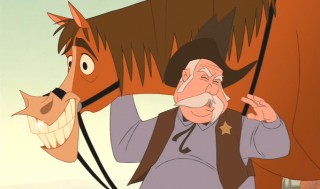
In Home on the Range,  the  sheriff finds himself in a similar situation.   He seems like a good guy, albeit weak and lazy, and is friends with the owner of the “Piece of Heaven” farm.   Nonetheless, he has to do the bank’s dirty work, evicting the woman from her house so that the bank and the villain Alameda Slim, make more money.  The sheriff knows that what he is doing is bad and even ask the owner to forgive him, but she knows the truth:  “Sorry isn’t going to save my farm!” With the sentence “I’m just doing my job,” the sheriff  justifies himself and continues to do bad things without feeling guilty.

The head of the company, Monsters, Inc., justifies himself similarly.   For him, the most important thing is the survival of his business during times of crisis; he inherited it from his family, employs many people, and provides electricity to the city.  But now, Monsters, Inc., is running out of energy, resources, and profits and is at its breaking point.

"I would do anything to save this company,” says the boss. “I don’t have a choice because the world isn’t the same.  Frightening [kids] isn’t enough anymore.”
"But kidnapping boys and girls?” asks Sully.
"I’m going to kidnap a thousand kids before I let this company die and will silence everyone who gets in the way!”

The boss is in control of Sully, the bank is in control over the sheriff,  the survival of the company controls the boss…Everyone wants to say that they don’t have a choice, that they only do bad things when they are ordered to do so.  In reality, they have the power to choose.  They can say that they won’t do it and they will look for other work.  But they don’t assume responsibility for their actions, and instead, blame others.
Helena and her cousin, Fernando.

The workers in the Nazi concentration camps made the greatest test of the excuse, “it’s my job.”  Their job was to kill Jews, gypsies, communists, and homosexuals.  After WWII, the whole world recognized that “it’s my job” doesn’t justify anything; the people that killed in the concentration camps are just as guilty as the ones who ordered them to do it.  To shift the question to a less serious context, imagine that a child does something bad and his mom asks why.  The excuse, “my brother made me do it”  doesn’t justify what he did.  Mothers know that each person has to be responsible for their actions and they will punish the child for what he did.   Nonetheless, when the police come to the neighborhood to kill poor people, we pardon the officials because they’re only doing their job.  This is the paradox that Monsters, Inc., and Home on the Range  highlight.

The other excuse of “good people” that do bad things is: “In reality, what I’m doing is good;” everyone knows the story of the father who abuses his children, saying, “I’m doing this for your own good!” Various movies clearly expose the hypocrisy of this discourse.  The slogan for Monsters, Inc., is  “We scare because we care”, as if scaring is a favor that the monsters do for kids.   This idea helps justify what the monsters do, but kids know very well that this is a thin and empty justification.   Similar is what the queen says in  A Bug’s Life, when she discovers that the “saviors” who came with Flick were nothing more than mere circus artists: “I never thought that that an ant would think of himself as more important than the colony."  In reality, what hurts the ants is the queen, in her conformity with exploitation, but she justifies her collaboration by saying that its for “the good of the colony.”

The clearest case of “for your own good” is Buck, the horse from Home on the Range.  Throughout the whole movie, he affiliates himself with the wrong side-first with the bank who wants to take Mrs. Pearl’s land and later, with the hypocritical vigilante, Rico- but in his fantasies, Buck is always the hero and that nothing  he does is bad.  His dreams are films, where the horse uses martial arts to fight the bad guys dressed in black, but Buck never goes beyond the black and white symbols to see what is really good and bad.   Here we encounter the ideology of the police: they might always hurt the people they are supposed to protect, but in their fantasies, what is really important is that they wear a blue uniform and define themselves as the “good guys.”

In all of these cases, ideology functions so that the rich, powerful, and oppressors can pretend that they are good.  And in each case, the movies show that these arguments are ridiculous, trying to remove the psychological support of the oppressor.  The movies also observe the question of the ideology from below, with different conclusions.

The crickets from A Bug’s Life manipulate the ideology so that ants don’t question the exploitation.  “The world is as it is,” they say.  “It’s imposible to change it, so it’s better to conform to it.”  According to this logic, the world has always been unfair and will always be unfair, but this is how it functions and it can’t function any other way.  It’s normal and natural.  This discourse was used to justify slavery during a large part of human history.   It was simply a natural thing, like the sun or rain, and it made as much sense to complain about slavery as it did to complain about heat in the tropics.   The world was like this.

The sentence that the crickets always use is: “you ants, you have forgotten your place!”  Be it the caste system in India, segregation in the United States, or apartheid in South Africa, the exclusion of  the marginal neighborhoods in Latin America, violence against women…it is always justified with “this is how the  world works.  The ants work, and the crickets take what they harvest.”  For a great majority of people, this kind of oppression becomes natural and normal, and is imposible to question or challenge.

Helena likes these movies... I hope she's getting this message out of them!

Wednesday, December 4, 2013

A Bug's Life in a Gang-Controlled Favela


One of Helena Iara's favorite films is A Bug’s Life, where the crickets make a living by stealing half of the ants’ harvest; they say that the seeds and leaves pay for the protection that the crickets provide for the colony, but in reality, its nothing more than a bribe. For the crickets, it’s fundamental that the ants remain ignorant about the power dynamics, because ignorance is their most powerful weapon, as we see when the crickets go to a fancy cantina to spend their dirty money.   They have so much fun that the gang members go to the boss and ask if they really have to return to the ant colony.  Life is already good, they say.  Why do we have to have to go through the trouble of blackmailing the ants just to get a handful of seeds?  The boss responds with a naked expression of power:

"If you let one ant question us, then you let all of them question us.  There are 10 little ants for each one of us, and if they figure this out, then our game is up!  This isn’t about food.  Its about control.  And that’s why we go back to the colony."

The crickets, like mafias all over the world, charge a “vaccine” or protection money, saying that they will protect the community from outside threats, when in reality, the gang is the greatest threat that the neighbhorhood faces.  The gang is only legimate as long as people perceive them as the only solution to their problems, but when people perceive their own power, they no longer need the gang.  The crickets manipulate fear and ideology so that the ants don’t become aware of their own pwer, of their capacity to be actors on the world’s stage.  As long as they are seen as weak and incapable, they will never become a threat to the powerful.

Helena with her cousin, Gabriela.
Almost the exact same story has happened in Medellín, Colombia.   In the context of chaotic violence, where anyone can die at any moment, the local gangs organized with two motives: to defend the public and to make money.  The problem was that when street crime stopped, the gang still wanted to make money, so they kept charging “the vaccine” – protection  money-from the people in their neighborhoods.   People complained but they still paid because they didn’t see any alternative and because they feared  the power of the gangs.

The strategy of resistance in Medellín, like in A Bug’s Life, begins with conscience.    First, as it well known in popular education, the oppressed has to become aware of the oppression, but later on has to be aware of his/her  own power and ability to do what the gang does.  In Medellín, the violence had fragmented the marginalized communities to the point where neighbors were afraid to talk to one another.   When there was conflict between them – land ownership, water that  left one family’s house and entered another’s-they would look to the gangs to resolve the conflicts.  And each time they would seek out the gangsters, they would recognize them as a legitimate power in the neighborhood, thereby justifying the exploitation.

The gang took advantage of its legitmacy, but didn’t really want to resolve conflicts since it was far from their fundamental mission: making money.   Therefore, when a group of youth from the neighborhood proposed that they be in charge of mediating conflicts, the gang passed on this responsibility with a sense of relief.   Nonetheless, when people realized that they could resolve conflicts on their own, the gang lost its legitimacy and disappeared within six months.       In A Bug’s Life, when the ants become aware of the fact that they can not only defend themselves from the dangers of the world,  but also frm the crickets that protect them—the gang also has to go.

But that's a story for tomorrow.