
The first answer that Sully and Mike offer to this question is one that we have heard several times: “It’s my job.” When police go to a poor neighbhorhood and begin to round up or beat people, people complain, “You’re also poor and you come here to abuse us? How shameless!” In many cases, the ones who defend the police will say, “Shut up, they’re just doing their job.” In reality, the content of this excuse is “it’s somebody else’s fault, the boss who tells them what to do. If he doesn’t do it, he’s going to get fired.” Almost everyone can identify with this problem-“do I lose my job or my ethics?”-therefore, the police are forgiven. And more importantly, the police pardon themselves and continue brutalizing the community.
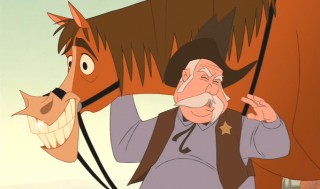
In Home on the Range, the sheriff finds himself in a similar situation. He seems like a good guy, albeit weak and lazy, and is friends with the owner of the “Piece of Heaven” farm. Nonetheless, he has to do the bank’s dirty work, evicting the woman from her house so that the bank and the villain Alameda Slim, make more money. The sheriff knows that what he is doing is bad and even ask the owner to forgive him, but she knows the truth: “Sorry isn’t going to save my farm!” With the sentence “I’m just doing my job,” the sheriff justifies himself and continues to do bad things without feeling guilty.
The head of the company, Monsters, Inc., justifies himself similarly. For him, the most important thing is the survival of his business during times of crisis; he inherited it from his family, employs many people, and provides electricity to the city. But now, Monsters, Inc., is running out of energy, resources, and profits and is at its breaking point.
"I would do anything to save this company,” says the boss. “I don’t have a choice because the world isn’t the same. Frightening [kids] isn’t enough anymore.”
"But kidnapping boys and girls?” asks Sully.
"I’m going to kidnap a thousand kids before I let this company die and will silence everyone who gets in the way!”
The boss is in control of Sully, the bank is in control over the sheriff, the survival of the company controls the boss…Everyone wants to say that they don’t have a choice, that they only do bad things when they are ordered to do so. In reality, they have the power to choose. They can say that they won’t do it and they will look for other work. But they don’t assume responsibility for their actions, and instead, blame others.
 |
| Helena and her cousin, Fernando. |
The workers in the Nazi concentration camps made the greatest test of the excuse, “it’s my job.” Their job was to kill Jews, gypsies, communists, and homosexuals. After WWII, the whole world recognized that “it’s my job” doesn’t justify anything; the people that killed in the concentration camps are just as guilty as the ones who ordered them to do it. To shift the question to a less serious context, imagine that a child does something bad and his mom asks why. The excuse, “my brother made me do it” doesn’t justify what he did. Mothers know that each person has to be responsible for their actions and they will punish the child for what he did. Nonetheless, when the police come to the neighborhood to kill poor people, we pardon the officials because they’re only doing their job. This is the paradox that Monsters, Inc., and Home on the Range highlight.
The other excuse of “good people” that do bad things is: “In reality, what I’m doing is good;” everyone knows the story of the father who abuses his children, saying, “I’m doing this for your own good!” Various movies clearly expose the hypocrisy of this discourse. The slogan for Monsters, Inc., is “We scare because we care”, as if scaring is a favor that the monsters do for kids. This idea helps justify what the monsters do, but kids know very well that this is a thin and empty justification. Similar is what the queen says in A Bug’s Life, when she discovers that the “saviors” who came with Flick were nothing more than mere circus artists: “I never thought that that an ant would think of himself as more important than the colony." In reality, what hurts the ants is the queen, in her conformity with exploitation, but she justifies her collaboration by saying that its for “the good of the colony.”
In all of these cases, ideology functions so that the rich, powerful, and oppressors can pretend that they are good. And in each case, the movies show that these arguments are ridiculous, trying to remove the psychological support of the oppressor. The movies also observe the question of the ideology from below, with different conclusions.
The crickets from A Bug’s Life manipulate the ideology so that ants don’t question the exploitation. “The world is as it is,” they say. “It’s imposible to change it, so it’s better to conform to it.” According to this logic, the world has always been unfair and will always be unfair, but this is how it functions and it can’t function any other way. It’s normal and natural. This discourse was used to justify slavery during a large part of human history. It was simply a natural thing, like the sun or rain, and it made as much sense to complain about slavery as it did to complain about heat in the tropics. The world was like this.
The sentence that the crickets always use is: “you ants, you have forgotten your place!” Be it the caste system in India, segregation in the United States, or apartheid in South Africa, the exclusion of the marginal neighborhoods in Latin America, violence against women…it is always justified with “this is how the world works. The ants work, and the crickets take what they harvest.” For a great majority of people, this kind of oppression becomes natural and normal, and is imposible to question or challenge.
Helena likes these movies... I hope she's getting this message out of them!


