Friday, July 11, 2014

Thinking amidst the ruins: Aladdin

Aladdin is a terrible movie.  Racist, incoherent, and the music is smarmy (and far too catchy: just try to get "A Whole New World" out of your head).  Helena and I watched it last night (Rita couldn't even stomach it, and I have to say I sympathized with her), and all of my criticisms from when I had seen it twenty years ago came back.  Even so... this blog isn't about throwing rotten tomatoes.  In spite of the aesthetic horror show on display, something is going on in the movie.

Robin Williams, in full Good Morning Vietnam manic mode, voices the genie, one of the few highlights of the movie.  The genie summarizes his existential problem: "Infinite, universal power... little bitty living space."  The genie can do anything, but only at the wish of the other.  He is, at the same time, infinitely powerful and a captive.

Some lowly scriptwriter at Disney managed to smuggle this theme into other parts of the movie: Jasmine is a princess, but she is also a prisoner of the power and wealth and little niggling rules that surround royalty.  Aladdin is completely free, but he has no power or money, not even enough to buy bread or an apple.  Finally, in the climactic scene, Jafar falls into the trap of asking for ultimate power... which also implies chains.  The movie sets up a dichotomy between freedom and possession (of power, of things) that reminds one of Janis Joplin's "Freedom's just another word for nothing left to lose."

Helena at a playground in Serra Talhada, in the northeast of Brazil
Like many little girls, Helena likes princesses.  She is pretty and dresses well, so many people in the street even call her "princess".  At the same time, she truly loves her freedom, the ability to go out into the yard and play in the sandbox, climb trees, get dirty as we walk through the jungle around the house.  Most narratives about princesses don't capture the consequences of royalty, the limitations that power puts on a child's (or an adult's) freedom.  As I suffered through Aladdin last night, I hoped that Helena would, at least, catch that message.

Aladdin offers a simplistic and deeply problematic solution to the problem of freedom vs. power: the abuse of power.  The law say that the princess must marry a prince... but the sultan can change the law!  The way to overcome the dichotomy between power and freedom is to accept a total despot, a ruler who is not ruled by the law.

As I said, it's an awful movie.  But at least it opens up some interesting questions.

Tuesday, July 8, 2014

It isn't the film: the Aristocats

Helena never fell in love with The Aristocats in the same way she did with Frozen or The Lorax, but for a couple of weeks, she watched the 1970 Disney movie with some regularity.  What has been interesting about the way she watches the film, however, is that she doesn't care much about the plot or the characters (except the young girl-cat, Marie).  Unlike in her Lorax or Jungle Book phases, she doesn't want to "play" the movie with me, Rita, or her friends.  Instead, she wants to sing the songs.

The first time that Helena watched the movie, she started at the beginning and went all the way through to the end, but since then, she has only really wanted to watch a couple of scenes, and she uses the iPad expertly to find them.  First, she finds the scene where Adelaide Bonfamille's lawyer comes to re-write her will.  The old lawyer sings a bowdlerized version of "La Donna è Mobile" from Rigoletto, and Helena and her cousin would watch the man prance up the stairs, laugh uproariously, and then run through the house and into the yard, singing "Ta da da bom-bi-yei, ta da da bum-bi-ye..." in a way that Pavarotti just might be able to recognize.  Helena's cousin Gabriela is now 9, and has a pretty decent singing voice, so the two of them managed to pull the music off.

Next, Helena and Gabriela would scan the control on the iPad to the next song they liked, "Scales and Arpeggios."


And then the would run through the house again, singing arpeggios and scales.  

Cartoons have long been a way to introduce children to "high culture" music, especially with the use of humor.  I clearly remember from when I was a little kid a Pepe Le Peu and singing opera, and of course many of the classic Looney Tunes used classical music as a background to the antics of the comical animals onscreen.  The Aristocats does something very similar, with the ridiculous lawyer and the three little cats giving kids and excuse to enjoy opera and even voice training exercises, but the movie tried to do something even more interesting, including French chanson and jazz in the "high culture" to which a cartoon could be the entrée.  

Unfortunately, Helena hasn't enjoyed the jazz as much as she enjoys the opera (the reverse of what I would prefer, especially in the coded economic language the film uses), but it has been great to watch her come to enjoy new kinds of music, both in this film and elsewhere.  She has always loved Brazilian country music, Motown, and some ballads, but this weekend she had a wonderful time dancing samba and forró at a party we went to, and she is now even "composing" songs on her guitar.  The most interesting part of the process is seeing how she enjoys sounds that are not normally considered "childish:" she loves minor scales and invents sad songs to go along with them.

If we let Helena chose what songs she wants to listen to on YouTube or the iPod, she will always list her favorite kiddie tunes.  Challenge her, though, and she comes to love many sounds you would never expect a kid to enjoy.  With that in mind, maybe Rita and I can put our own music on the stereo again without feeling that we're excluding our little girl...

Tuesday, July 1, 2014

Would you eat it in the favela? (Part 3)

The last of three posts on Green Eggs and Ham: Click here for the first and second.

------

            It turns out that Marília had her own Sam-I-Am, her friend Adriano.  Adriano is a classic “good kid,” but even when Marília was deepest in the gang, he always insisted on their friendship.  “He wasn't pedantic,” she told me.  “He never told me what to do, or that I was being bad, but he was always there, living a different kind of life from me and my friends.”  They chatted in the alleys of the favela, he listened to the funk lyrics she composed, and from time to time he would invite her to join the dance group he organized.  And one day, months after her boyfriend had murdered her sister's boyfriend, when Marília felt like the funk gang had gotten boring, when she was tired and run down, Marília heard Adriano's voice.  She accepted his invitation to dance in his group, and together they invented a choreography that told the story of her life.
 
Adriano (the "Sam-I-am" of this article) with Helena and me in
Triunfo, in the interior of Pernambuco.
          
In Dr. Seuss's story, it took a train crashing into a boat and everyone nearly drowning before the un-named nay-sayer decided to say “yes” to green eggs and ham.  The series of tragedies that befell Marília were more violent, but something similar happened in the favela of Arruda: exhausted and beat up, she decided to try something else.  In the end, though, the result is the same: “Thank you, thank you, Sam-I-am” was mirrored by the depth of gratitude I saw on Marília's face as she and Adriano described their choreography.  “Thank you,” she told him, that secular manifestation of grace.
            The recent craze among parents for Pamela Druckerman's Bringing Up Bébé, a book about the superiority of French parenting, brings to light a fantasy adults have about their children: that kids need not force adults out of their perfect, ordered, and pleasant lives, that children need not disrupt.  For Druckerman, French parenting means that babies always sleep through the night, kids eat all their food, and mothers can continue to talk about fashion and art with their friends as they sit in cafés.
            But whether it's Sam-I-Am, street kids, Adriano, or my daughter, we have to remember that children disrupt.  That's what they do.  They threaten our comfortable order, our received ideas, our schedules, our sense of propriety and modesty.  This threat is painful, difficult… and in the end, liberating.  I spent most of my life declaring that I never wanted kids, but when my daughter Helena came along, I found out that I did, in spite of all of my protests, like green eggs and ham.  That conversion didn't come with a lightning bolt out of heaven, but with laughter and crying and playing, sleepless nights and the constant learning of a baby.  Working in the midst of gang wars, child soldiers, and gangsters, I've had lots of opportunities to walk the road to Damascus, but nothing has changed me like Helena has.  I think most parents would say something similar.
            One can make a pretty good argument that iconoclasm in Judaism, Christianity, and Islam is a way of saying, “Religion is not about a person's relations with things, rituals, or symbols.  The only route to God is by loving and being just to other people.”  Iconoclasm delivers this message in the visual realm, but I wonder if we can't say something similar in the field of hearing: might the disturbing silence of God be a way to force us to listen to the other?  Instead of listening for the voice of God, does that silence force us to listen directly to widows and orphans and foreigners, those three great figures of Levitical law? 
            Sam-I-Am and Adriano remind us, I think, that our listening isn't enough.  The silence of God also means that street kids, undocumented immigrants, and others who stand in for the orphans and sojourners of lore have to talk.  God isn't going to do it for them.  They needle and irritate and offer and persist… until finally we hear the call of justice in strange words like “Would you like them in a box?  Would you like them with a fox?”
            I wonder if Sam-I-Am doesn't also help us to re-read the Bible.  Saul walking the road to Damascus may have a parallel in Green Eggs and Ham, when the train falls into the boat: the voice of God is only the final moment in a long story.  As Saul persecuted Christians, can we imagine victim after victim looking into his eyes with a persistent, questioning “Why?”  Or seeing a child pull at his cloak to say, “Please don't hurt my mother!”  Without them, would Saul have been able to hear God's voice?  Saul and God get the leading roles in the drama of Acts, but in his desire to tell a clear and compelling narrative, Luke may have missed the real protagonists of the story.
            Dr. Seuss and the favelas of Brazil make for a strange juxtaposition, but for me, conversion and grace will never look the same again.

Monday, June 30, 2014

Would you eat them in a Favela? (Part 2)

Last week, I began a long reflection on Green Eggs and Ham.  If you missed the first part, you can find it here.  The conclusion is here.

------


            There is an important reason for this difference between the conversions in the Book of Acts and the one in Green Eggs and Ham: power dynamics.  The un-named nay-sayer in Green Eggs and Ham has all the characteristics of an adult: he is taller, he reads the newspaper, he is easily irritated by Sam-I-Am, he is set in his ways.  Sam-I-Am is clearly a child: smaller, playful, unafraid of rejection.  Unlike the Hebrew God, Sam-I-Am cannot convert his opponent with pyrotechnics and miracles.  His only resource is his playful persistence. 
            It might be useful to think through the problem spatially.  When prophets hear the voice of Yahweh in the Tanakh, they always have to look up.  Paul's conversion follows the same model:

And as he journeyed, it came to pass that he drew nigh unto Damascus: and suddenly there shone round about him a light out of heaven: and he fell upon the earth… [Acts 9:3, my emphasis]

Yahweh calls on prophets to support the suffering, the poor, and those who suffer from injustice (those “below”), but this call comes from “above”.  That's the voice we're used to hearing and obeying, after all: parents, judges, leaders… they all come from above.
            Let me turn back to Marília for a moment.  In the favela, she stands at the top of the hierarchy: she reigns over the gang as she wishes.  In the stateless zone of the favela, no police officer or politician can tell her what to do.  Unless some God decides to intervene, there is no figure who can call her to conscience from above.  And from below?  Why should she listen?  Her world is working as it should.  Unfortunately, few powerful people – whether in a small pond like the favela of Arruda, or at the peak of state power – feel the weight of an ethics that calls us to hear the pained cry of the other.  The powerful and evil may be the ones most in need of conversion, but it's unlikely they are going to do it themselves.
            Enter Sam-I-Am.  In the face of the constant “no”, the unwillingness of the un-named interlocutor even to countenance the possibility of green eggs and ham, Sam-I-Am keeps trying.  He refuses to hear the “no” that his powerful interlocutor always calls back to him.  He persists.
  •  
             Half a dozen years ago, I worked in a Colombian shantytown controlled by paramilitary gangs, teaching children how to make movies; the kids were excited to use this new technology to show a bit of their community.  As we filmed in this very dangerous place in the mountains above Bogotá, a gang member would often come up, point at where the kids were filming, and say “You can't do that.”
            “Oh, no, that's not what we're filming,” the kids would say.  “We’re shooting there.”  They pointed their fingers to something off to the side of what worried the gangsters, indicating that they were interested in something else.  With this simple motion, they felt like they could continue to film as they liked.  The gang authorities, completely unprepared for anyone to disobey their orders, accepted the kids' explanation with a bemused grunt.  Then, we moved on to the next spot and had to do it again.  There's a wonderful obverse here to the parental lament that “you aren't listening to what I'm saying”: kids persist, even in the face of words that try to stop them.
            It's interesting, I think, that Sam-I-Am has the name Samuel, based on the Hebrew verb that means “to hear,” when he, like the kids in the Colombian shantytown, is most characterized by the remarkable ability not to hear.  Sam-I-Am reminds me of the street kids I've worked with for almost two decades, their cleverness, humor, and their capacity to annoy an adult until they get what they want.  Without the power or theological fireworks available to God, they have to use the tools they have on hand to get what they want.

Friday, June 27, 2014

Would you eat it under an umbrella? Would you like it in the favela?


Up until now, most of my posts in this blog have been about movies... but Helena loves books even more, so I'm going to start writing about children's literature as well.  Here, the first part of an extended "think piece" I've been working on about Dr. Seuss and social change.  As anyone might guess, Helena loves Green Eggs and Ham, and it turns out to be a pretty useful book to think about violence in the favela.

            Marília was twelve or thirteen when she joined the funk gang.  She danced well, she sang even better, and she loved the camaraderie of the group, the sense that someone always had her back, even in the most violent alleys of the favela where she lived.  Her ability to compose songs and her fearlessness quickly made her one of the gang's leaders, and she used her new authority to challenge gangs from around the city to more and more violent brawls.  Beautiful, tall, and with a newly dyed shock of blond hair, she became one of the most feared people in Recife, Brazil.
            Gangsta Funk is a kind of ritualized violence, based on repeated challenges using music, almost an esthetic duel of insults and affronts, as if the Jets and the Sharks from West Side Story had come to life, dancing and singing and fighting to a funk beat.  The most respected members of the brigades are creative composers, who invent lyrics to laud their friends and denigrate their enemies.  Marília knew how to rhyme taunts into unforgettable challenges, but she also found she was gifted as a field marshall, organizing battles so well that her gang, once the laughing stock of the city, never lost.
            Marília concentrated her power in the funk gang by taking as her boyfriend the boss of the gang that controlled drug trafficking in the favela.  The two gangs had always cooperated in defending the community, so it was a political as well as romantic match.  When her sister started to date the leader of the gang on the other side of the canal, it looked almost like one of those arranged marriages to cement Hapsburg and Bourbon alliances in early modern Europe. Everyone thought that the two banks of the Canal de Arruda would come to dominate both trafficking and funk in the city.
            Two years ago, a gang from third favela tried to take over both sides of the canal, and suddenly the alliance became fragile.  A raiding party from Marília's neighborhood killed a couple of boys on the other side.  The funk insults began to rain down.  Finally, in a pitched battle, Marília's boyfriend murdered her sister's boyfriend.
            Were Hollywood to make a movie of Marília's life, that murder would open the climatic act of the film: either the chaos and anarchy of revenge (if Tarantino were directing) or the passage into redemption (Clint Eastwood as director, maybe).  Whether we look at Paul on the road to Damascus, the call of the Hebrew prophets, or the evangelical trope of being born again, in the West we like our conversion to come like lightning from heaven, or at least with the drums and gunshots of a movie soundtrack.
            As Marília talks about who she has become, though, the story sounds less like the voice that came to St. Augustine in Milan, and more like a book we don't generally think of theologically: Green Eggs and Ham.
  •  
            Green Eggs and Ham gives intellectuals an excuse to let their hair down.  Jesse Jackson famously read the verses in the cadence of Martin Luther King on Saturday Night Live, and everyone from computer scientists to mathematicians to Mormon theologians[1] has used the book to theorize playfully about their favorite subjects.  Here, though, I'd like to suggest that when we read Marília's story together with Dr. Seuss, we learn something about how people really change.
            Almost every American who has had a child or been a child since 1960 knows the basic plot of the book: thirty-five years passed between my childhood and when I began to read it to my daughter, and I still remembered most of the rhymes by heart.  As the book opens, a tall, nameless character with a hang-dog look tries to sit quietly and read his newspaper, but Sam-I-Am won't leave him alone.  First, the rascally Sam-I-Am rides by on a dog, then on a tiger, and then sets the story in action by forcing a plate of food under his nose and asking, “Do you like green eggs and ham?”  After a first refusal, Sam-I-Am offers the green eggs and ham a total of eleven times in more and more ridiculous and dangerous places before his interlocutor, exhausted, finally accepts.
            And here, the conversion: the food he had rejected again and again becomes the food he loves the most, and a beatific smile descends on his face.  My 22 month old daughter is so thrilled by that smile that she starts reciting the book's last words – “Thank you, thank you, Sam-I-Am” – well before the final page.
            Here, conversion is nothing like the blinding light that shines down on St. Paul in Caravaggio's painting, nor like the 3000 people transformed by Peter's preaching in the Book of Acts.  The conversion in Green Eggs and Ham isn't about charisma or drama or power; it happens only through the perverse persistence of Sam-I-Am, who finally exhausts every “no” that the other character can offer.

More on Monday and Tuesday...


[1] See, among others, Lachlan Forrow, "The Green Eggs and Ham Phenomena", The Hastings Center Report. Vol. 24, No. 6 (Nov. - Dec., 1994), pp. S29-S32, which looks at the difference between what hospital patients say they want and what it turns out they wan; Randy Haupt, "Green Eggs and Ham."  IEEE Antennas and Propagation Magazine, Vol. 51, No.3, June 2009; M.J. Kaiser , S.H. Cheraghi, "Green eggs and ham" Mathematical and Computer Modelling.  Volume 28, Issue 1, July 1998, Pages 91–99; and Robert Patterson's quirky and quite funny "Hebraicisms, Chiasmus, and Other internal evidence for ancient authorship in Green Eggs and Ham." Dialogue: A Journal of Mormon Thought. Volume 33, no. 4, winter 2000, pages 163-168.

Monday, May 12, 2014

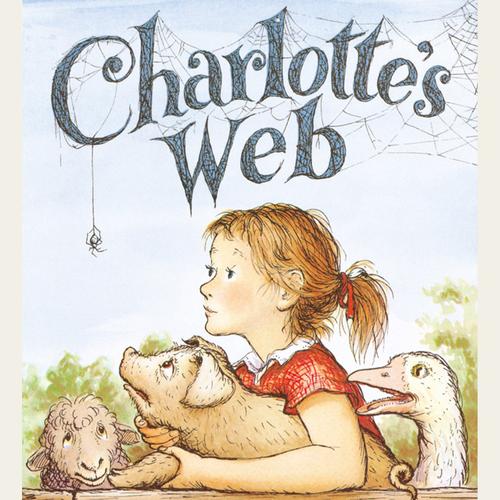
Written in the web: more on Charlotte

It may well be, as I suggested in my last post, that EB White missed a great opportunity to expand children's perspective when he chose to project human emotion onto farm animals, instead of finding ways to introject the very strange "thoughts" of animals into his great children's book, Charlotte's Web. However, reading the book slowly gives us (both children and parents) the opportunity to see some very important things.

The book is almost interesting enough to do a line by line exegesis, but that would bore any reader of this blog silly (even so, it is tempting: consider where I could go with the father's line after Fern convinces him not to kill Wilbur, the runt of the litter: "This morning, Fern went out to right injustice in the world.  She came back with a pig."  Is there a better expression of the life of those of us trying to work for social change, the contrast between the lofty ideals and the hard, often dirty work of the day to day?  But I digress).  Instead, I want to focus on one idea, that Wilbur is a special pig, a particularly noteworthy animal, as he is lauded in his special prize at the fair or by all of his fans who come to the farm.


Truth is, Wilbur isn't at all special.  He's just a pig.  People see him as special because of the work of the invisible Charlotte, who almost literally disappears into the arrow she makes to point at Wilbur.  She begins with the very simple descriptor: "Some Pig."  The message is superfluous: of course Wilbur is some pig.  He is not no pig.  The writing in the web merely points to his existence: there is some pig here!  However, when the hired man Lurvy finds the writing in the web, he is so stunned by the miracle, that he cannot see the words as just a description.  Instead of "some pig [lives here]", the interpretation must be "Some Pig [this is]!"

As Charlotte sees a way to use these words to save Wilbur's life, the writing becomes more and more transparent: she describes Wilbur as "Terrific" and "Radiant" before the final understatement of "Humble."  But once again, the truly amazing character in the story, the one who deserves to be lauded as something truly out of the ordinary, is not Wilbur but Charlotte.  At one point, Mrs. Zuckerman points this fact out, but very quickly the focus of attention returns to Wilbur.

The references to miracles might make us think that something theological is going on, and it might be interesting to walk down that hermeneutic road.  We could see Charlotte as John the Baptist, who appears to have been a much more impressive preacher and political figure than Jesus, but who gets pushed to the back of the official story.  Or maybe mention the Rudolf Bultmann's idea that in Christian thought, we are confused by the fact that the messenger is the message: not anything that Jesus says, but his simple being-in-the-world.

There seems to be an easier interpretation, though, given who EB White was: a journalist.  Journalists write about other people, and those people get the credit and the fame, while the writer fades into the woodwork.  The New Yorker, where White worked, was very clear about effacing the journalist behind the journalism, drawing attention to the message instead of the messenger.

The basic point is what is interesting, though: what makes something special isn't necessarily anything essential to it, but rather what points to it.  Wilbur is a spacial pig, but not because he is really more radiant, more terrific, more clever than any other pig.  Charlotte points to the pig and says he is special, and because of the miraculous capacity of her writing, others come to see Wilbur as special.  When they then treat him as special, he becomes what they want to see in him.  Radiant?  Well, then we wash him in buttermilk, and he becomes radiant.

Kung Fu Panda does something very similar: the great secret to the Dragon scroll is not some esoteric wisdom that will give Po the ability to fight.  It is only a mirror, showing the panda to himself.  "There is no special ingredient in the special ingredient sauce," he reflects (upon finding that there is no magical spice in his father's noodle soup).  "It is special when people believe it is."  With that, Po magically can defeat the great warrior leopard... the story doesn't have as much verisimilitude as Charlotte's Web.

All of this is an empty, if vaguely interesting, interpretation, until we remember that both Charlotte's Web and Kung Fu Panda are directed principally to kids, and only secondarily to intellectual parents looking to find something interesting as they read or watch the stories over and over again.  Kids need to see themselves as special: it's the way that they find themselves in a huge and frightening world.  In a democracy, however, we can't let accept the specialness of aristocrats or kings, and we are reluctant to upset the delicate equality of people.  One solution is that "we are all special," but the son in The Incredibles has an easy response to that: "If everyone is special, then no one is."  Charlotte's Web, and to a lesser degree Kung Fu Panda, offer a more interesting answer to kids' anxiety: you are special because someone loves you, because someone sees you as special.

With that, we have to remember the social practice of reading Charlotte's Web.  My father read it to me.  I read it to Helena.  Though some kids may read the book on their own, mostly it is a family event, something that we do together.  The effort of reading many pages to a child says "I want to put this much effort into being with you.  I like to be with you and tell stories."  Both the message of the book and the messenger (the parent reading it) carry the same meaning to the child: "You are special because I love you."

And with that reflection, I think I understand a bit better why I loved the book so much as a child, and why Helena asked me to start reading ti to her again last night.

Saturday, May 10, 2014

Talking spiders: Charlotte's Web

When I began to write this Children's Media Critic, I wanted to focus on kids movies: I had seen so many parents dismiss these films as simply something to entertain the kids, and I wanted to show that like any work of art, if you look at KidVid carefully, you will learn many unexpected things.  I should remember, though, that books are also a medium of communication, and on a day-to-day level, Helena spends more time reading (or more accurately, listening to) books than she does watching a movie.  So today: Charlotte's Web, which we just finished reading last night.

For those who are a long way form childhood, a quick summary of the novel: Fern, a little girl form a farm, convinces her father not to cull the runt of a pig's litter.  She adopts little Wilbur, feeds him from a baby bottle, and takes him for a walk in a stroller.  Eventually, however, she has to sell him to her uncle, who has a farm big enough to keep the pig.  There, lonely Wilbur meets Charlotte, a gray spider, who writes words about him in her web -- radiant. some pig, humble -- thus winning attention for Wilbur, a win at the county fair, and a stay of execution from becoming bacon.  In the end, Charlotte dies, but several of her many daughters stay with Wilbur on the farm.

Like with any book, the genius is in the details, especially in EB White's elegant prose.  It was only years after my father read me the book that I found out that White was one of the great writers for the New Yorker and enough of an authority on style and grammar that his book was an obligatory reference in high school and college.

Rita, Helena, and I are now working in communities where, like in children's literature, animals and humans communicate.  There is, however, a profound difference between Charlotte's Web (all of the children's literature descending form Aesop, really) and Amazonian Indian thought.  When animals in European and North American children's books talk, we hear the voice of a human being. Wilbur's fears and prides are those of a small child; Charlotte cares for him like a (human) maiden aunt.  The purpose of putting animals in the center of the story is to elucidate human interactions and lessons.

Among Amazonian Indians, however, one tells stories about animals as animals.  You want to get into a jaguar's head because you want to know how he hunts, and so learn from him.  The shaman enters a trance and transforms himself into a caiman in order to understand why it hunts the children from the community.  Like in Charlotte's Web, animals in human stories are there to serve human purposes, but instead of projecting human characteristics onto beasts, the Amazonian narrative projects the beasts' perspective into us.

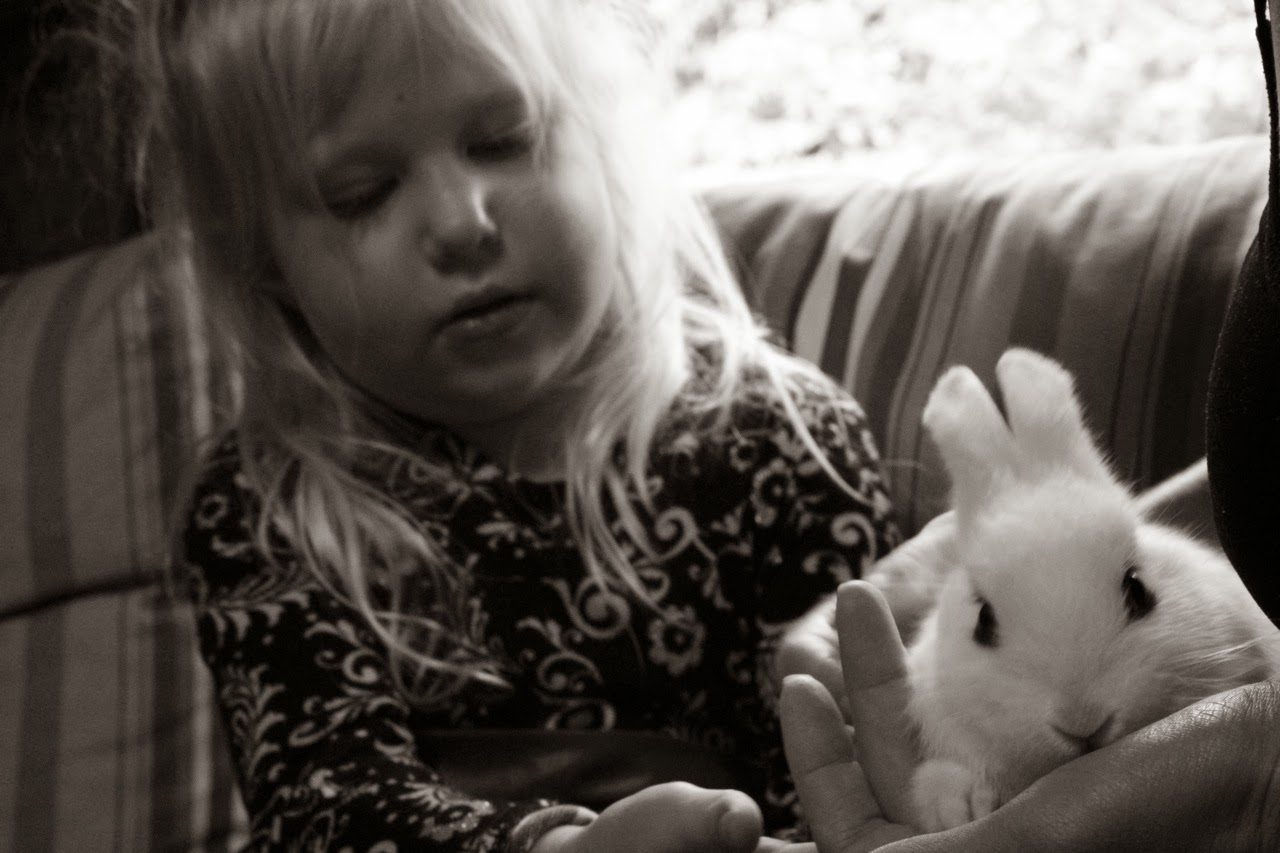
Helena just got a baby rabbit for her birthday, and it has been fascinating to watch her interact with the little creature.  At first, she treated it as a doll.  Then she saw it as her baby.  She is an observant little girl, though, and she has come to see that none of these relations come to terms with the profound otherness of the rabbit, the something else that lies behind the blue eyes of the furry white thing.  Animals have a very different way of seeing the world from people, and I'm sad that European kids stories miss that in their attempt to teach moral or personal lessons.

On the other hand, the freedom to play with ideas that comes with animal stories opens up wonderful possibilities for reflecting about all sorts of things.  Over the next couple of posts, I'll talk about that, more liberating, aspect of Charlotte's Web.