Monday, May 5, 2014

Colonialism and Chaos: The Jungle Book

Helena Iara had her Jungle Book phase about 4 months ago, but over the last couple of days she has been talking about it again, wanting to play at Baloo and Mowgli.  She sings the Bear Necessities, and sometimes asks to see the monkey scene.  As she watched it last night, I began to think about the story symbolically.  Here is the Louie King of the Jungle song, in case you don't remember it:


Before anything else, I think we need to do some symbolic unpacking.  The song is New Orleans Jazz, and the voice sounds like Louie Armstrong. It is actually Louis Prima who sings; Disney first wanted Armstrong to sing, but then was concerned about a black man voicing an ape.  The expedient of changing the race of the singer doesn't really resolve the problem, however, when we see that the movie isn't really abut American racism, but about colonialism.  Rudyard Kipling, who wrote the book upon which the Disney film was based, was the great apologist for the British Empire in India, and the movie actually nods rather honestly in that direction: the elephants, for instance, parody British military virtues.

Let's look at the basic message of the song:

"Now I'm the king of the swingers
Oh, the jungle VIP
I've reached the top and had to stop
And that's what botherin' me
I wanna be a man, mancub
And stroll right into town
And be just like the other men
I'm tired of monkeyin' around!

Oh, oobee doo
I wanna be like you
I wanna walk like you
Talk like you, too
You'll see it's true
An ape like me
Can learn to be human too..."

Here is the basic conceit of colonialism, especially in the "White Man's Burden" form defended by Kipling: the poor, black, deprived "other" in the non-European world wants to be like Europeans.  London is the culmination and apex of what it means to be human, so any way that the Europeans can help these poor deprived people become like Europeans -- even if it means stealing their resources, running their lives, destroying their culture, and even killing them -- is completely right and justified.  Perhaps some jungle kings did want to "walk like [Kipling], talk like [Kipling]," but the truth is that most people would prefer to be in charge of their own lives and make their own decisions.

I should also point out that if the ape wants to be like Kipling, then Kipling (and other beneficiaries of Empire) don't have to think so hard about whether their life is really all that good.  If they want it, well then I'm happy to have it.  (This, by the way, is the essence of the French Feminist Critique of Freud's idea of penis envy, but that's a story for another essay)

Helena, her friend Luc, and her cousin Gabriela.
At first, then, the song looks like an apology for colonialism, white words put into the mouth of the ape/primitive.  As it continues, however, it becomes a much more interesting story.  After all of the dancing and singing, Louie and the apes become aware that Baloo is really a bear, and they try to chase him out of their city.  As they run around and fight with the great bear, they destroy their entire city.  As Baloo and Mowgli flee at the end of the scene, the entire beautiful place falls in on itself, culture turned to rubble.

And what happened with colonialism?  Europeans, unable to see the wealth and depth of African, American, and Asian cultures, didn't care in the least what they destroyed.  Sometimes the destruction was architectural, like in The Jungle Book: think of Cortés in Tenochtitlan or Pizarro in Cuzco.  Other times, it was cultural, as with the British and French in Africa.  But in the end, colonialism knocks it all down.

Even worse, it appears that the apes themselves have destroyed their own city: their act of resistance is what brings the stones down on their own head.  Those who have lived through wars of independence know this situation perfectly: fe years before the Jungle Book was released on screen, we saw the same thing happening in Algeria, as the French blamed the Algerians for destroying their own cities.  

Is the Jungle Book an anti-colonialist screed?  Probably not.  But if we look at it carefully, it does tell the truth -- if in a coded way -- about a nasty episode in world history.

Saturday, May 3, 2014

A film for adults: Shrek 4

I'm not quite sure when the Shrek franchise started to tell the story of my life.  Not in 1 or two, clearly (I haven't rescued many princesses or defeated any evil fairy godmothers), but somewhere in Shrek 3, about the moment when Fiona is yelling out to Shrek on the boat leaving the harbor, the movies began to get too close to home.  Painful, incapacitating anxiety about fatherhood?  Yep, got that one.  Nightmares about vomiting babies?  That too.  And then, Shrek 4.  I'd seen it when it came out, right after Helena was born, but yesterday they had it on TV here in Brazil, and it hit hard.


The plot line is pretty amazingly complex, and I found myself explaining what was going on to Helena and her cousin more than a few times.  Family is great for Shrek... except that all of those good parts repeat and repeat and repeat and repeat, ad nauseum.  (Literally, in fact, given the tendency of the little ogres to throw up on their parents)  Family life, for all of its charm, has become meaningless.  Finally, Shrek explodes at a birthday party: he longs for his old life of adventure and violence, when the villagers would hunt him with pitchforks and he would destroy them with strength and fear.

Been there, done that.  OK, not the nostalgia for violence and pitchforks, but in the first years that Helena was with us, I could only remember the wonder of climbing so high in the Andes that I couldn't breathe, hiding behind concrete walls in Medellín so that bullets wouldn't hit me; lonely nights camping in the jaguar preserves of Central America or hitching across northern Colombia with drug traffickers.  From the outside, why would these sort of things inspire nostalgia?  They seem as miserable as Shrek's lonely life in the swamp.  But that kind of a life breeds stories worth telling.  When you look back, it seems adventuresome and meaningful and special, while the day-to-day pleasures and pains of caring for a child, as wonderful as they are at that moment... they don't make for epic narrative.  The Iliad, as far as I know, includes no scenes of changing diapers.  Or of making faces at a baby and sharing a joyful first laugh.

Shrek thinks he has found a solution, or at least a break, when the evil Rumplestiltskin gives him the chance to go back to his old life in exchange for "one little day, one you don't even remember" of his life.  That day, of course, is the day Shrek was born.  By losing that day, all of history will change, and Rumplestiltskin will be king.  Shrek has to re-conquer Fiona, overcome the evil King... but the more important struggle is to see that "You don't know what you got till it's gone."  Only from the outside, from the perspective of loss, can he see the wonder of his family.  And, in the process, the experience becomes a story, worthy of being told, being filmed, being proud of.

Helena liked the movie.  It's funny, it's well animated.  But the moral of the story isn't for her.  It's for me, and for fathers and mothers like me.  A simple moral, I suppose (even an 80s heavy metal ballad I remember from hight school includes the lyric "You don't know what you got till it's gone" (followed, melodramatically by "Every cowboy sings the same, sad song").  But as a wonderful philosophy professor of mine once told me, "Truth of it is, most important things that philosophers say, everyone already knows them.  Not clever, not worth a huge book and a tenured job.  But we should still say them, again and again."

Monday, April 14, 2014

Let the storm rage on: Frozen

Obsession with Frozen hardly makes Helena Iara unique.  Half of the little girls who pay attention to movies (and maybe a quarter of little boys?) have probably joined her in watching it at least 15 times since the DVD release a couple of weeks ago.  And as usual, I can only tolerate seeing the movie that many times by overthinking.  So I'll skip the easy (and very cool) things that a lot of critics talk about (the feminism of the movie, the fact that only 1% of Hollywood movies have two female leads, the redefinition of an "act of love") and go straight to the heavy philosophy.

In the mid-20th Century, the idea of structuralism took over continental philosophy: thinkers like Claude Levi-Stauss, Roman Jacobson, and Louis Althusser took a basic insight from linguistics and turned it into a way to understand the whole world.  In language, no sound means anything of itself, but only in opposition to something else: for instance, in Spanish, all of the sounds from b to v are pronounced the same way, but in English, it makes a big difference if you say "bile" or "vile."  Sounds come to be important when we learn to distinguish them from very similar, but minimally different, other sounds.    Structuralists made this insight into a rule of the universe: for Levi-Strauss, cultures had to divide the things of the world between the "raw" and the "cooked", between "high" and "low" and many other divisions.

At the same time, Disney began to put fairy tales on the screen, and (consciously or not) their movies fell into these structures.  There were active men and passive women.  Envious, serious villains stood against funny, collaborative heroes.  Real, loving family was opposed to resentful stepmothers.  I don't know if anyone ever did it, but structuralists would have had a field day with early Disney movies.

At first, Frozen appears to follow this kind of logic.  The never-opening door to a bedroom divides two sisters, the ice queen Elsa and the gregarious, funny Anna.  Anna lives in the world of "Inside" and dreams of the freedom of "out", symbolized by the first time that the windows open ("I didn't know that they did that any more," she sings).  Hans is smooth, urbane, social; Kristof is a awkward, poor, a loner.  According to the songwriters, the original draft of the script even had an evil Elsa against a good Ana.


The song "Let it Go" marks the end of the film's easy oppositional structures.  It was written ambiguously, so that Elsa could end up either good or bad, depending on the final script, and this ambiguity is the music's genius.  The first time I saw the movie, I thought I was seeing a genealogy of the Disney witch: how does the queen in Snow White or Malificent in Sleeping Beauty come to be who she is?  At the end of the song, her clothes are transformed into rock-star sexy and her ice castle constructed on an unreachable crag.  Though the song is "inspirational", as many commenters have said, the inspiration is rather Nietzschean: 

It’s time to see what I can do
To test the limits and break through
No right, no wrong, no rules for me
I’m free

Elsa has attempted to place herself "beyond good and evil."  The good girl, trapped behind her door by her feeling of guilt for almost killing her sister, becomes the witch. We have taken the first step beyond structuralism, seeing that the "good-evil" dichotomy, so central to 1950s Disney movies, can in fact be different sides or even different moments, of the same young woman.  The song, with its pounding piano-rock rhythm (so like the mid 1990s Tori Amos and unlike most Disney) captures this explosion of a-moral freedom perfectly.

By the end of the film, Elsa has become the good queen, redeemed by love (the love of her sister, not that of any man: perhaps this is why figures on the political right have accused the film of promoting lesbianism).  She has learned to control the power of the cold, using it for the good of Erindell.  If Elsa locked into her room, trying to control her power, is a symbol of the cruel superego, then the end of the movie is the happy ego.  Here's the point, though, and one with which Lacan, if not all psychoanalysts, would certainly agree.  There is no direct road between the repressed hysteria of Elsa locked in her room, and the relatively well adapted Elsa of the last scene.  To get from superego to ego, she must pass through the id.  She must traverse the fantasy of using and abusing her powers in the most extreme way,

I don’t care
What they’re going to say
Let the storm rage on,
The cold never bothered me anyway

Among the many problems of traditional Disney movies, we should list the passivity of the heroine's journey to womanhood.  She suffers, but always because of the actions of others (the poison apple, the witch's curse), and it is the action of the (male) hero that turns her into a (happy) woman.  In Frozen, Elsa must make her own way through her own dark night of the soul, tarrying with the negative (of her witchcraft) before finding her way out.  She externalizes her cold, which is no longer part of her being, and now something that she does to the earyh

I'm always reluctant to applaud the products of multinational capitalist corporation, but Disney got something right this time.


Monday, March 3, 2014

Cuerdas

Helena's newest favorite video, a Spanish short that just won the Goya award.  Though I haven't found a version with English subtitles, you can understand the movie without them.


Honestly, I have nothing to say to add to the beauty and sadness of this wonderful little film, just that I am proud that Helena finds it so powerful.

Saturday, February 22, 2014

Watching and reading and playing: The Lorax Part 3

Helena's Lorax binge is slowly coming to an end, so it's about the right time to write the last of my encomia on the movie.  Today, I want to think about what this experience of repetition and (almost) obsession says about the relationship between video, books, and play.

Helena rock climbs "outside of town."
The American upper-middle class has a very moral relation to the television.  Though only some people see it as positively evil, most see it as a sort of low grade vice, something we love, but that we should watch in moderation.  A visual version of Doritos, maybe.  A couple of days ago, we bought Helena some DVDs of the PBS series "The Cat in the Hat Knows a Lot about That", and the liner notes are largely dedicated to the problem of guilt.  "No need to feel bad," goes the argument.  "You put your kids in front of this, they give you a bit of a break, and they'll still be learning something."

The problem lies in the idea that if kids start to watch TV, they will never voluntarily stop.  And if you don't run and play and read and learn, the kid will turn into a couch potato.  Helena's experience of the Lorax shows something very different going on: instead of the movie being a kind of "gateway drug" to more TV, it has actually been the gate to activities American parents generally see as the sublime childhood virtues: reading, creative play, and independent storytelling.

I had read The Lorax to Helena before she started to watch the movie, but it was only after she saw the story on TV that she fell in love with the book.  She now wants me to read it daily (if not more), and has requested it in Portuguese and even in Spanish (the library had a Spanish translation; Rita had to do the Portuguese herself).  She also spends time "reading" the book alone, and has memorized so much of the text that it probably her reading probably isn't that different from mine.

Her obsession with the Lorax has also made Helena into an active storyteller. Part of our house has become a Truffula forest, and often she and I play at being brown barbaloots or singing as humming fish. When we go out on a hike or to a playground, one part of the area will be "outside of town," another part will be the Truffula forest before it was destroyed, and then there will be a place called "Thneedville."  Rocks and pinecones play the role of truffula seeds, and we go around planting them in the snow or the sand, depending on the weather.

After all of this, I am much, much less worried about Helena watching TV.  As long as we watch with her and encourage her play, it seems much more a prod to virtue than a "book tube."

Monday, February 17, 2014

Helena speaks for the trees: The Lorax Part II

In my last post, I looked at how creating a back-story for the Once-ler and the boy in the Lorax helped to provide a more thoughtful and effective critique at the motivations behind environmental destruction. This morning, I want to think a little bit about Thneedville, the plastic city that stands at the center of the 2012 movie, but which didn't even exist in the original book.

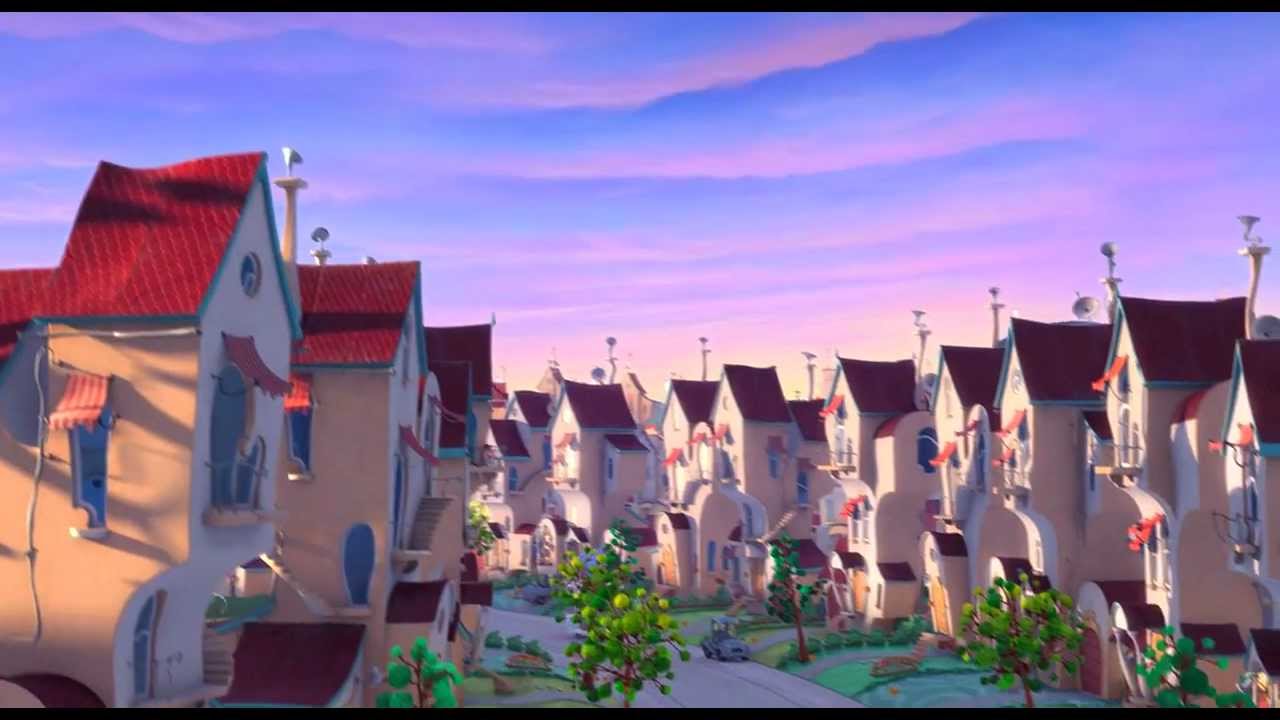
Dr. Seuss's story of the Lorax begins on the far side of town, where the grickle grass grows, but the movie starts in a mock-up of suburban America, in a song and dance number about the virtues of a clean, plastic world in which one even has to buy air.  The color palate is dramatically different from the first pages of the book, with bright reds and yellows and greens (the sort of colors that Seuss used in all of the rest of his books, and in the flash-back parts of The Lorax).  Dr. Seuss begins with these colors because he wants to tell a dystopic fable of the future.  Forty years after the publication of the Lorax, that future has come upon us, and it doesn't look like Seuss thought it would, so the movie made the very smart decision to begin with a new visual (and political) frame.

Thneedville, from the first frames of the movie
Truth is, it is very easy to fight against an evil as obvious as the smog and pollution in the Lorax book.  When things are that bad, people are able to see how bad they are, and at least some people will have the courage to act: who wants to live amid smogulous smoke, gloopidy-gloop, and the demolished landscape the Once-ler made?  In the late 1960s and early 1970s, when Dr. Seuss wrote the book, those seemed like good metaphors for environmental destruction: the Cuyhoga River that caught on fire, the persistent smog of Denver or Los Angeles, the clear-cutting of the Oregon forests.  Thanks to non-governmental organizations, the EPA, and car exhaust laws, those easily visible environmental problems are largely gone today, at least in the United States.

Today, we face an entirely different environmental crisis, one that you can't see by looking out the window.  Global warming destroys reefs and slowly raises the level of the seas, but our lawns are still green.  Our hamburgers depend on the deforestation of the Amazon, but that happens (in the language of the Lorax) "outside of town," in places that most of us never see.  Our cheap computers and home appliances and clothes depend on the devastation of China's air and rivers.  But the small world we live in, inside the huge walls of Thneedville, continues to appear almost perfect.  The movie presents a much better portrait of today's environmental crisis than the book.

Helena, about a year ago, on a boat on the Amazon river
The movie also ties together marketing, profit, and power in a very interesting way: at one point, two advertising executives present a new way to sell air, now in little plastic bottles.  "Our research," one points out, "show that if you put anything in little plastic bottles, people will buy it!"  Anyone who has seen a Dasani water vending machine next to a water fountain will certainly laugh guiltily.  Second, they point out, "The factories to make the water bottles will pollute the air even more, so that people will need to buy even more air!"  Even the most radical environmental organizations are seldom brave enough to tie capitalism and environmental destruction to closely together.

---------


Helena celebrates a successful rock climb
in the forest above Santa Fe.
For Helena, the opposition between Thneedville and Outside of Town (the basis for all of the Lorax games that she invents and wants to play with us) must be particularly touching.  Even as a little girl, as she travels between Brazil and the US, between our home and the Amazon, she must feel the difference between the plastic world of so many people, and uncontrolled nature -- sometimes sublime and beautiful, other times destroyed and tragic.  Several times in the last week, she has told me that she misses the trees in the jungle that surround our house in Brazil.  We have gone hiking and climbing several times in the last couple of weeks, and she feels so free and happy in the juniper and piñon forests of Santa Fe.

Many people never leave the plastic perfection of Thneedville; Ted (the boy in the film) is transformed when he learns that he can go between the two worlds.  Helena, however, always already lives on both sides of the wall, inside plastic post-modernity and in the jungles and mountains.  We adults have many intellectual tools to understand and rationalize the contraction between Thneedville and Outside of Town; Helena, fortunately, discovered The Lorax as a way to think her two worlds.

Saturday, February 15, 2014

Helena speaks for the trees: The Lorax

Over the last three weeks, as I have been lain flat on my back by an attack on my sciatic nerve, Helena has watched, read, and acted out The Lorax at least a hundred times.  Though I had read her the book before, this extraordinary attack of repetition began when she saw the 2012 version, made by the same people who did Dispicable Me, but has reached on to include the early 1970s film broadcast on TV, two editions of the Dr. Seuss classic, the spanish version, an improvised Portuguese version (Helena has insisted that Rita translate the book), and numerous games in playgrounds, at home, and in the woods above Santa Fe.  As you might guess, I have had quite a bit of opportunity to compare different variations on the story -- almost as much as a Biblical text critic looking at 17 versions of the Gospel of John in different greek monasteries -- and I have come to a rather unexpected conclusion: the highly commercial, computer-driven 2012 version is the best of all of them.  Yes, even better than Dr. Seuss's book.


No knocks to Dr. Seuss here: The Lorax was one of my favorite books when I was a kid, Rita bought it for me to read to Helena before our little girl was even born, and I had memorized most of it even before Helena got into this Lorax craze.  The movie, however, manages to be even more politically radical -- and at the same time more hopeful -- than the book.  Helena has been right to fall in love with it.

A book -- especially a poetry book -- can be a fable, but a movie can't really get away with that.  The characters need back stories, clear motivations, a framework for identification and catharsis.  The movie gives as the Once-ler as a young man, naïve and hopeful that he will change the world with his Thneed.  He's not the faceless evil of the book, but a sympathetic guy, a little clueless, but a portrait of young America at its best.  After cutting down the first truffula tree, he comes to see that the Bar-ba-loots and the Swammy Swans and the Humming fish all depend on the forest; he agrees not to cut any more trees.  He and the Lorax chat, dine, and play cards together: they become friends.  Before he is a success, we identify with the Once-ler, we like his music and his innocence.

Evil doesn't come from inside the Once-Ler, but from a nasty one-two punch: the demands of the market and the weakness of his family.  After failing to sell even one Thneed for days, the Once-ler throws it away in frustration... only for it to land on the head of a cute teenager.  Everyone confounds the Thneed for a fashionable hat, and the floodgates are loosed.  Hundreds of people march on the forest, each demanding a Thneed.  Second, when the Once-ler calls his family to help him produce Thneeds in the factory, we see his weakness: as he had left home, his mother said, "Now if you don't succeed, dear... then it's just what we expected!"  As she, his father, aunt, and the rest of the family arrive on the scene, we see how much he wants their approval and love.  When his father points out that to increase production they need to cut down the trees instead of just gathering the tufts, we can see the internal debate on the young Once-ler's face.  Finally, his need for family approval overcomes his promise to the Lorax, and he says, "Well, cutting down just a few trees can't hurt..."

This expansion of the story is much more honest to how evil comes about in late capitalism.  It isn't just, as the Lorax puts it, that the Once-ler is "crazy with greed," but that he is weak.  The market wants Threeds.  His family wants success.  He is flattered by their desires for him, for their ideas that he can fulfill what they want.  The Once-ler accepts the desires of other people as his own desire, even though they will not make him happy, either.  If we look at Google in China, Nike in Indonesia, Apple and Foxxcom... the backstory of the Once-ler explains that kind of banal evil much more than the simplicity of greed or malice.

Helena at the Wildlife Conservancy Preserve outside of Santa Fe.
A return to the innocent days of the Once-ler also explains his final act, keeping the last of the Truffula seeds and giving it to the boy (unnamed in the book, named Ted in the movie as a tribute to Ted Geisel, Dr. Seuss's given name).  Wracked with guilt, the Once-ler is himself unable to do anything to right his wrong, but Ted gives him the opportunity at redemption.  The Once-ler is not a bad person, but a person who has done many bad things, and has become a prisoner of that history (symbolized by the slats he nails to his window so that no-one can see him... and so that he cannot get out.

The movie also gives us a backstory for the boy who goes to the far end of town where the grickle-grass grows.  He's a young teenager in love, and the girl wants to see a tree.  For a Brazilian, the story reminds us of the strategy of the Brazilian Communist Party, which worked to recruit the best looking young women, who would in turn inspire men to join... but it also rings true.  As the Once-ler remarks to Ted, "If a guy does something stupid once, it is because he is a guy.  But if he does it two times, there is sure to be a girl in the story."

Ted, like the Once-ler, is living someone else's dream... but he soon takes it on as his own.  He comes to care about trees, to long for nature and clean air.  He soon brings in Audrey (the cute girl; her name is probably a tip of the hat to Seuss's second wife) as an ally, and not only as an object of desire.  In this way, the film recognizes that just as the motivations of those who do evil are not always evil, the motivations of those who do good are not always pure.

In my next post, the subversive critique of Thneedville...