Tuesday, May 16, 2017

Reading Hermione when you're 7

As kids grow up, they watch movies in a different way. When Helena was little, she cared mostly about movement and color, though she also liked music. As she grew up a little more, she came to like plot — she would tell and re-tell the stories of the movies she had seen, transforming them in her play with dolls or friends. Next, she seemed to care most about theme, especially the way that The Lorax taught about environmentalism or Frozen’s ideas of sisterly love. I’m not sure if this is a common series of phases for kids and literature/film, but it does seem to track something of the way that Helena “reads” the movies she watches.

At seven years old, character seems the most important issue to Helena. Who are these people on the screen, what do they want, why do they want it, and how are they like and unlike me? This development seems part and parcel of Helena’s new and strong friendships and her wish to understand what the real people in her life think and want.

This new dynamic has played itself out most clearly in the person of Hermione Granger. About three months ago, I began to read the Harry Potter books to Helena, and Hermione jumped out of the pages at her. After we finished the book, I let her watch the movie (I think it is a bit much for a six year old — especially the penultimate scene — but she loved it), and once again, she fell in love with Hermione. In the middle of this, we also went to the movies to watch Beauty and the Beast, starring none other than Emma Watson, a grown-up Hermione Granger. Helena didn’t think much of the movie, but she loved the lead character.

When I was about six, one of my neighbors won the lead part in her high school presentation of the musical Brigadoon. I remember my excitement about “going to the theater” to see her, and then the unexpected feeling of seeing my some-time babysitter on stage. The, an even stranger feeling, as the voice that I heard emerging from her throat was not the voice of my neighbor. Confused, I kept pestering my parents, until finally they explained, in hushed voices, that she had laryngitis; the voice coming through the loudspeakers was the music teacher, singing into a microphone off stage.

Why would I remember this small piece of my childhood? Probably because this complex web of role-playing (my neighbor playing the part of Fiona, her teacher “playing the part” of my neighbor’s voice) brought me into the world of representation, the seemingly simple idea that one person can interpret the role of another, stand in for them. If you try to think like a little boy or girl, representation is suddenly a very complex idea: how is it that one person (and actor) can suddenly “be” another one, speaking with a new voice and playing a new role in the social network? As Helena became fascinated with Emma Watson (playing both Hermione and Belle), I saw that with movies, things are even more complicated. One day, Emma/Hermione is 11 years old; the next, she is a full grown woman. Kids have to learn about representation, but also about how time passes for an actor, but not for the character once she is inscribed onto film.

Helena has a certain advantage on many children as she learns about representation: her parents make movies. Eighteen months ago, when we filmed The Princess in the Alleyway with young actors from the favelas of Recife, we hired a couple of professional actors. One, Walter da Matta, played a spectacular villain, brutal, cold, and crule. In real life, Walter is the complete opposite, and he and Helena struck up a great friendship on and off the set. Any time that she confuses and actor and his part, I just have to remind Helena about Walter. Most kids don’t have that luxury.

All of this reflexion brings me back to the original idea of this blog post: children watch movies differently than adults do. It’s only gradually that they see plot, theme, and (if Helena is a model) character. And then, suddenly, when they decide to identify with a character — or the actor who plays that role — they drive right into the deep end. When I read Harry Potter to Helena now, Hermione need just enter the scene for Helena to perk up her ears or sometimes even cheer.


I really appreciate that JK Rowling wrote that kind of a character for Helena to identify with.

Wednesday, July 22, 2015

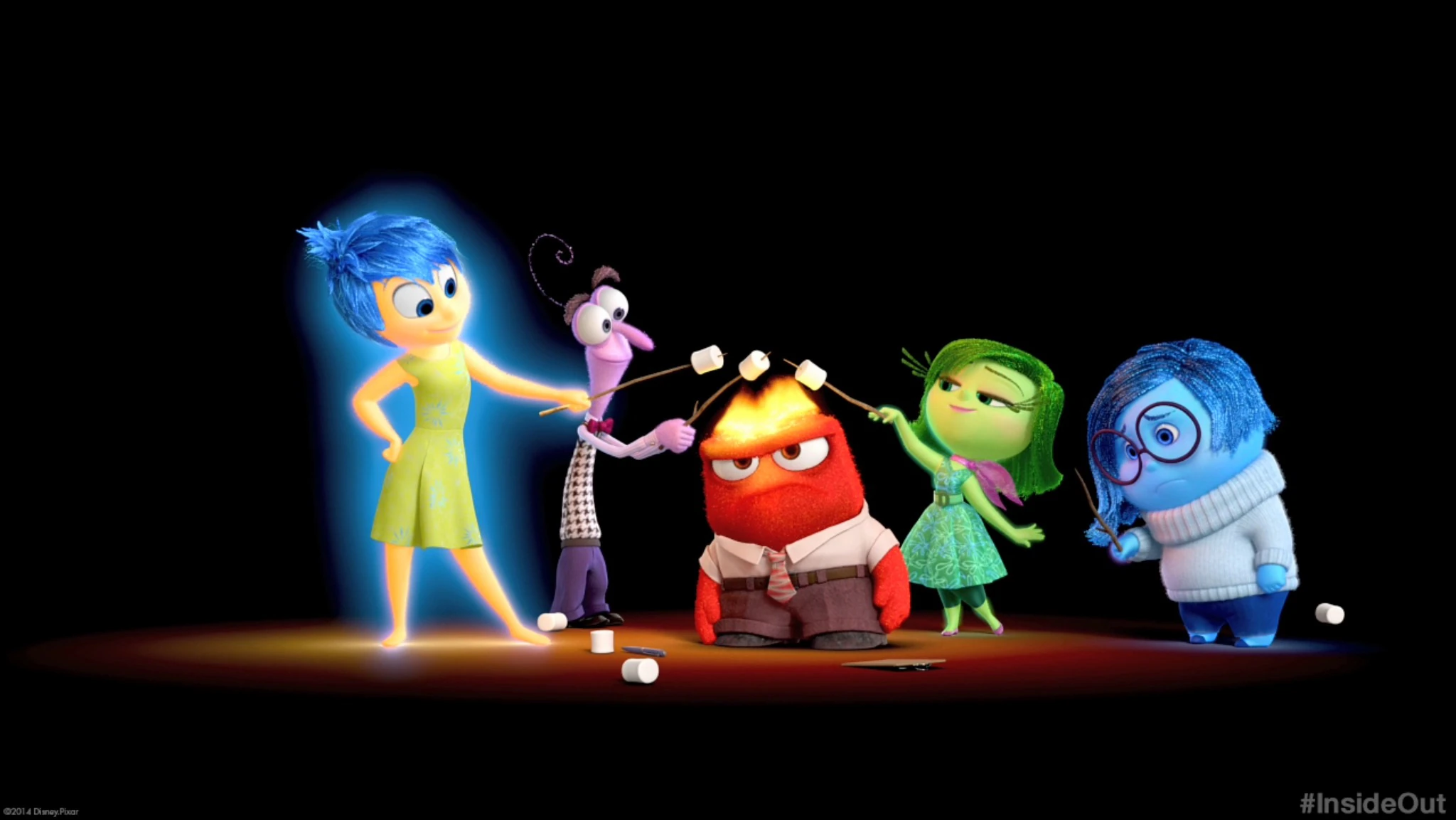
Watching Inside Out in Brazil

It takes a lot of years living in another country to understand exactly how much emotions are affected
by culture. And sometimes, watching a movie or reading a novel throws those differences into stark relief. Watching Inside Out in a Brazilian cinema was one of those moments.

Internationally, Brazilians are famous for their joy: the extravagant shows of carnaval, the contagious beat of the samba, Ronaldinho's playful smile as his dribbled past year another open-mouthed defender. Living here, however, one sees that Brazilians are as comfortable in sadness as they are in joy: people express their melancholy openly, in a way that many Americans would see as embarrassing, death is not a taboo subject, and when you listen carefully to the lyrics of those great sambas, most of them are about sadness.  For instance:

O samba é pai do prazer,
O samba é filha da dor
O grande poder transformador

(Samba is the father of pleasure,
Samba is the child of pain.
The great transformative power)

One of the things that Rita (my Brazilian wife) always comments when she goes to the United States is that happiness is obligatory, while sadness is seen as a failure or even a sin. When Americans feel sad, we have to hide it, and if people we love aren't happy, we see that as a failure, too. For Rita, this kind of obligatory happiness is extremely difficult... and after a couple of years living here, I have to say that I agree. Americans have turned emotion into morality, with happiness standing in for good, and sadness for sin.

(The Brazilian theory of the relationship between joy and sadness, by the way, is that sadness is a kind of rest. Just as one must sleep in order to be awake, one must be sad from time to time in order to be joyful. Music and dance play the role of mediators between the two.)

In this context, Inside Out says something truly revolutionary to Americans. When Riley (the little girl in the film) becomes depressed, it is not because she is really, really, really sad. That depression happens when sadness is banished from the "Command Center:" depression is not an excess of sadness, but the lack of it. And perhaps even more significantly, when you banish sadness, you also banish joy.

Loads of pop sociology and pop psychology could emerge from this insight, but I'll leave that to everyone else. For me, the movie serves a a kind of touch-point for a series of lessons I have been learning over the last fifteen years in Brazil: sadness is not a sin and emotions are not ethics. And when we are able to accept that sadness (and many other emotions Americans would tag as negative) are a positive and enriching part of human experience, we will be much better people.

And we'll probably be less depressed, too.

Thursday, June 25, 2015

Ella Enchanted: Kant gets lost in a fairy tale

For those who know a little of the uncharted wasteland of teeny-bopper television, what I am about to write will come as a surprise: Ella Enchanted is genius.

I'm not referring to the esthetics of the movie, nor even its humor (which is pretty good), but, oddly enough, to its philosophical basis. Unexpectedly, this seemingly frivolous movie places itself in dialogue with Kant, Lacan, and Zizek. But before I go on to defend this radical thesis, let me tell the story:

Ella is born into a home where fairies are part and parcel of everyday life, and though the story is based (very loosely) on Cinderella, it steals a conceit from Sleeping Beauty. The fairies find themselves in a kind of contest to give the best present to the baby, and the final fairy gives the best thing she can come up with: the "gift of obedience." For the parents, this gift is often a blessing: they can tell the child to sleep or eat or behave, and Ella has no choice. She will obey.

Any parent will have mixed feelings about such a gift, because as much as we prize the autonomy of our children (and I even like Helena's rebellious streak), there are times when we just need them to do what they are told. How much despair leaked into my life because Helena would not sleep when I was totally exhausted, and how many fights have we suffered when she simply refuses to eat broccoli even as she recognizes that it is one of her favorite foods. (That
is not a misprint: when not being stubborn, she loves broccoli, squid, octopus, raw fish, and any number of foods you would not expect a five year old to  enjoy). In the end, though, to our modern, liberal ears, obedience sounds more like a curse than a gift.

The first half of the movie plays the "gift of obedience" for laughs, and with no little success. As Ella's stepsisters learn that she will always do exactly what they command, they condemn her to a series of misadventures and petty crimes; her first encounter with the prince is complicated by the simple orders of "stay here and wait" or "listen to me," the stuff of daily conversation that we only see as an order as we laugh at Ella's response.

Finally, Ella heads off on her mission to find the fairy and ask her to take back the gift/curse. Walking through the woods as she begins her quest, the cries of "help me!" force her to obey and save an elf from his torture. As he screams advice to her, she takes the words as commands; and since she must do what she is commanded, in fact she fights like a king-fu master.

In the tumbles and turns of the plot, Ella learns of the oppression of the ogres and giants, finds a weak ally in the prince and heir to the throne, and finally makes her way to the capital city of the kingdom. To this point, the plot seems rather like that of Shrek, a simple inversion or deconstruction of fairy tale tropes, but with Ella's encounter with the prince's uncle, the evil Regent Edgar, the tale becomes much heavier. Edgar discovers the gift of obedience and commands Ella to kill the prince in the hall of mirrors at midnight, though she has (of course) fallen in love with him.

In spite of all of her attempts to overcome the regent's evil command, Ella finds herself in the hall of mirrors with the prince, a dagger in her hands. She tries to resist, but the gift of obedience does not brook exceptions: the blade moves closer and closer to her lover's heart, and all of the commands she has heard in her life echo through her memory. Then, suddenly, she sees herself in a mirror, and recognizes the secret: instead of being commanded by others, she will command herself. Looking at herself in the mirror, she declares, "You will no longer be obedient!"

Suddenly, instead of just being entertained by a funny movie, we find ourself face to face with German idealism, with the quandary of free will, and with the basic challenge of rearing a child.

If we look carefully at ourselves, we see biological demands (hunger, warmth, etc) and environmental influences (we have learned to do certain things, picked up other habits...). Looking at almost any "free" decisions we make, we can explain it as an inevitable result of biology and psychology... so where is free will? We are all, looking at it scientifically, cursed with the "gift of obedience".

Emmanuel Kant may have been the first philosopher to formulate the virtue of human autonomy as split in two. With reason (he postulates reason, but we can also talk about tradition, love, even the mirrors of a fairy tale), we can formulate what is right and project ourselves upon it: this is what Kant calls duty. "Duty?" the reader asks. "Isn't that just another kind of obedience?" And in fact, it is... but a different kind of obedience. For Kant, reason and duty are a kind of mirror which allows us to step back, look at ourselves in a cruel, objective light, and command ourselves. The opening between what I naturally or culturally want and what I declare to be my duty opens up a gap, a way to decide between one and the other. It's that decision, that break, that shows us to be truly free.

We can talk about the same issue in terms of parenting. Many progressive parents try to help their children to be free by allowing them to do what they want. After all, in politics, a government that controls personal behavior is tyrannical; we want to avoid that kind of oppression at home, as well. The problem is, however, that children are not instant adults. Obedience may be the negation of our desire to "do what we want", but it also allows us to make a second, later step, that of commanding (and obeying) ourselves, instead of someone else. (there's a long essay here on Kant's relationship with Hegel and the negation of negation, but I'll spare you).

Ella Enchanted seems like yet another throw-away, a flash in the pan directed to pre-teen girls... but in fact, it may teach them one of the most important lessons they (and we) have to learn.

Wednesday, August 20, 2014

Peter Pan: The story inside the story

A couple of years ago, working with pre-schoolers in the favelas of a city close to Rio de Janeiro, Rita and I made a very strange little film: we recorded a young boy "reading" picture book based on the Disney version of Peter Pan.  In his telling -- living as he was in a favela controlled by gangs, where shootouts between dealers and cops often happened right in front of the day care center -- the story was about nothing but violence.  "Then he hit her, and she hit him, and then they all hit each other."


In general, I have watched the movie in little pieces, looking over Helena's shoulder in an airplane or in a bus, and... it is pretty easy to see the story as this little boy does.  There is a lot a fighting in the movie: Peter against the pirates, Wendy against Tinkerbell, Wendy against the mermaids, the Indians against the lost boys, Hook against Tiger Lilly, Hook against his crew, Hook against Snee...  Fighting is one of the two ways that people seem to relate to each other in the story.

It's the second way, however, that I find more interesting and production.  People certainly fight with each other in Peter Pan, but they also tell each other stories.  Wendy tells stories of Peter Pan to her younger brothers.  Peter Pan listens at the window to these stories, and tells them to the lost boys.  Peter invites Wendy to be a mother to the Lost Boys, where the essential aspect of mothering is to tell stories to them.  Once Peter makes peace with the Indians, they tell stories to the Lost Boys...  In the end, narrative is one of the fundamental ways that people relate to each other, and that reflects the fact that traditionally, parents have narrated the book to their children at bedtime.

What I find most interesting and subversive in the story, however, is that the characters of the story like to hear stories about themselves.  Peter Pan comes to the Darling house in London, just so he can perch on the window and listen to Wendy's stories about himself.  It's at that moment that Nana, the dog, is able to capture Peter's shadow, the event that brings together story-teller and story-told.

The way that Peter enjoys the story tells about him seems to me a good way to express the independence of fictional characters.  Once they have been invented in stories, they do have a life of their own, going in directions that their authors never planned.  In some cases, like that of little Alan who sees Peter Pan as a sort of uncontrolled vigilante, the character becomes a stand-in for the fantasies and fears of the reader, and in the process, goes far beyond what the author might have wanted.  Any author, however, may see that a personage that she herself created no longer obeys her.  As I have written fiction, I often want the story to go a certain way, but then I think, "But that character wouldn't want that, couldn't do that."  The story, supposedly mine, ends of obeying the character I created and (wrongly) thought I controlled.

Now whether, like Peter Pan, they like to hear those stories, I don't know.  I don't have a dog to catch their shadows at night.

Friday, August 15, 2014

Robin Hood: the social bandit as Republican hero

I always loved the Robin Hood story when I was a little kid.  The little guy struggling against injustice whatever the cost, the transgression of the formal law in service of a greater good, the critique of inequality and royal power.  I don't particularly remember when or where I saw the Disney version of Robin Hood, but the foxes and the archery contest are clear in my head, so my guess is that the movie was the start of a long passion for the story, one that would end even in the publication of a book on social change philanthropy, Robin Hood was Right.


Given this history, I certainly wasn't expecting the movie that Helena has been watching over the last couple of weeks.  Yes, it's the same movie it always was.  It's just that in the current political context, it seems to mean something very different than I ever took it to mean.

The movie, I saw only now, transforms the story into one only about taxes.  Injustice is not exploitation, repression, or the exclusion of the saxons by the normans.  Though Prince John, Hiss, and the Sheriff of Nottingham are clearly bad guys, the only way they express this evil is by charging high taxes.  The voiceover that tells and retells this story is a supposed "folk-singer" who "tells it like it is."

Though I was offended by the interpretation of the movie, it goes a long way to understanding the political confusion in the United States, where working class populism almost always ends up supporting exactly the people who want to screw the working class.  The Tea Party is the perfect contemporary manifestation of this problem, where (legitimate) anger at the way that the rich and businesses control the US government becomes a way for the rich and corporation to cement their control over government.  The supposed injustice of taxes (really lower in the US than in any other industrialized country) is the tool that the unscrupulous right way uses to engage in this political judo.

The movie first came out in 1973, a time when an honest movie about a social bandit (Eric Hobswawm's term for criminals who gain social legitimacy from their moral and financial support of oppressed or marginalized groups) would have been interpreted as support for communism.  Nixon was president (soon to be expelled).  But the film might also have worked in the 1950s or in the 1920s.  America has to re-interpret popular struggle as against taxes, and not against an unjust economic system.

Here, however, is the irony.  I don't remember the movie this way.  Helena doesn't seem to care in the least for the story line about taxes.  Kids, after all, don't pay taxes: that part of the story doesn't touch them.  What they like is the idea of cute animals and little kids standing up against oppression: not understood as the Tea Party or the John Birch society (mis)understands oppression, but as little kids experience it.  Helena likes the movie, and I hope that will be one little step on her way to care about making a world that is a little less unjust.  Just like it did for me.

Tuesday, July 22, 2014

Let it Go, Let it Grow

Helena's favorite two movies are The Lorax and Frozen, and as she has been singing the songs from both, it has become increasingly obvious that something similar is going on.  The anthem for Frozen, as everyone knows, is Let it Go.


The Lorax, though very successful, hasn't become such an integral part of pop culture, so you may not have heard Let it Grow, sung at the climax of the movie.


Let it Go, Let it Grow.  Even the melodies have something similar to them.  I don't think plagiarism has anything to do with the similarity, but that both movies are tapping into something very interesting about the zeitgeist.

Helena Iara also uses the same "Let..." construction, and quite often.  I notice it, because (informed by Portuguese grammar, which makes more sense to her) she will always say, "Daddy, let I climb on this chair..." or any other number of things she thinks I may or may not allow her to do.  This little gramattical error, however, points to the most interesting thing about Let it Go, Let it Grow, which is to say, who is the agent of the action?  When one says "Daddy, let me do x," who is the actor and who is acted upon?

Helena on the dunes near our house in Florianópolis
Let's look at how other similar sentences work: "Daddy, give me" or "Daddy, lift me" (in one case, the me as indirect object, the other as direct object), it is pretty clear that Daddy is the actor.  Daddy lifts, Helena is lifted.  Daddy gives, Helena has something given to her.  With "Let me", we seem to follow the same logic: Daddy is allowing, Helena being allowed.  "Let I," or the Portuguese "Deixa eu," confuses things more than a little bit.  I becomes the subject, the agent, while Daddy is more a barrier to be overcome.

What does Elsa mean when she declares the desire to "Let it Go"?  She is, in fact, freeing herself from social, gender, and age constraints.  There is no Daddy here to allow or not to allow he to be herself, only the unwritten rules of society, the disdain she fears that she will face, what "They" will say.  Elsa is very clearly the agent of the change, the subject of the sentence.  Interestingly, in the Portuguese translation of the song, we hear "Livre estou": I am free.

In The Lorax, the Once-ler's thneed factory has killed all of the truffula trees, and no plants can grow in the the city that has been built on the ruins of the forest.  Ted and Audrey, the young protagonists, get a last seed from the Once-ler and try to plant it in the middle of town, but the most powerful businessman in Thneedville wants to stop them.  Finally, convinced by Ted and Audrey, the people of the town sing "Let it Grow" as a way to reject the businessman's attempt to keep oxygen as a commodity that only he can sell.  (I've already written on the radical politics of the Lorax, if you are interested)  It seems, then, that the implied subject of "Let is Grow" is the businessman: "Hey, you, let it grow!"

Helena with her friend Luc
In fact, though, what would keep the tree from growing is the people as a whole: before Ted and Audrey convince them of the virtues of trees, they are fully on the side of keeping Thneedville as it is, "plastic and they liked it that way."  The command is not really given to O'Hare, the businessman, but to the people themselves.  "Let is grow" is the way that the people give a command to themselves.  Exactly the same is true of Elsa: she can only let herself be free by directing a plea to "Let it go" to some unknown figure who is the real agent of the story.

But who is the agent?  To whom is the "let" directed?  Elsa is talking to herself; the people of Thneedville are talking to themselves.  In fact, what we see here is a split between the thinking self and the acting self, where one tries to tell the other what to do.  Though this break might seem schitzophenic, in fact it is quite honest.  What is really keeping the people of Thneedville from cultivating trees isn't some abstract law or an oppressive power (even Mr. O'Hare): it is themselves.  Elsa's freedom is also limited more by herself, by her fear of what others will say, than by those others.  So in fact, while it might be more direct to say "Let's cultivate trees" or "I am free," both social agents need that detour in order to allow themselves to do what they want.

Amazing how complex the lyrics to children's songs can be...

Friday, July 11, 2014

Thinking amidst the ruins: Aladdin

Aladdin is a terrible movie.  Racist, incoherent, and the music is smarmy (and far too catchy: just try to get "A Whole New World" out of your head).  Helena and I watched it last night (Rita couldn't even stomach it, and I have to say I sympathized with her), and all of my criticisms from when I had seen it twenty years ago came back.  Even so... this blog isn't about throwing rotten tomatoes.  In spite of the aesthetic horror show on display, something is going on in the movie.

Robin Williams, in full Good Morning Vietnam manic mode, voices the genie, one of the few highlights of the movie.  The genie summarizes his existential problem: "Infinite, universal power... little bitty living space."  The genie can do anything, but only at the wish of the other.  He is, at the same time, infinitely powerful and a captive.

Some lowly scriptwriter at Disney managed to smuggle this theme into other parts of the movie: Jasmine is a princess, but she is also a prisoner of the power and wealth and little niggling rules that surround royalty.  Aladdin is completely free, but he has no power or money, not even enough to buy bread or an apple.  Finally, in the climactic scene, Jafar falls into the trap of asking for ultimate power... which also implies chains.  The movie sets up a dichotomy between freedom and possession (of power, of things) that reminds one of Janis Joplin's "Freedom's just another word for nothing left to lose."

Helena at a playground in Serra Talhada, in the northeast of Brazil
Like many little girls, Helena likes princesses.  She is pretty and dresses well, so many people in the street even call her "princess".  At the same time, she truly loves her freedom, the ability to go out into the yard and play in the sandbox, climb trees, get dirty as we walk through the jungle around the house.  Most narratives about princesses don't capture the consequences of royalty, the limitations that power puts on a child's (or an adult's) freedom.  As I suffered through Aladdin last night, I hoped that Helena would, at least, catch that message.

Aladdin offers a simplistic and deeply problematic solution to the problem of freedom vs. power: the abuse of power.  The law say that the princess must marry a prince... but the sultan can change the law!  The way to overcome the dichotomy between power and freedom is to accept a total despot, a ruler who is not ruled by the law.

As I said, it's an awful movie.  But at least it opens up some interesting questions.

Tuesday, July 8, 2014

It isn't the film: the Aristocats

Helena never fell in love with The Aristocats in the same way she did with Frozen or The Lorax, but for a couple of weeks, she watched the 1970 Disney movie with some regularity.  What has been interesting about the way she watches the film, however, is that she doesn't care much about the plot or the characters (except the young girl-cat, Marie).  Unlike in her Lorax or Jungle Book phases, she doesn't want to "play" the movie with me, Rita, or her friends.  Instead, she wants to sing the songs.

The first time that Helena watched the movie, she started at the beginning and went all the way through to the end, but since then, she has only really wanted to watch a couple of scenes, and she uses the iPad expertly to find them.  First, she finds the scene where Adelaide Bonfamille's lawyer comes to re-write her will.  The old lawyer sings a bowdlerized version of "La Donna è Mobile" from Rigoletto, and Helena and her cousin would watch the man prance up the stairs, laugh uproariously, and then run through the house and into the yard, singing "Ta da da bom-bi-yei, ta da da bum-bi-ye..." in a way that Pavarotti just might be able to recognize.  Helena's cousin Gabriela is now 9, and has a pretty decent singing voice, so the two of them managed to pull the music off.

Next, Helena and Gabriela would scan the control on the iPad to the next song they liked, "Scales and Arpeggios."


And then the would run through the house again, singing arpeggios and scales.  

Cartoons have long been a way to introduce children to "high culture" music, especially with the use of humor.  I clearly remember from when I was a little kid a Pepe Le Peu and singing opera, and of course many of the classic Looney Tunes used classical music as a background to the antics of the comical animals onscreen.  The Aristocats does something very similar, with the ridiculous lawyer and the three little cats giving kids and excuse to enjoy opera and even voice training exercises, but the movie tried to do something even more interesting, including French chanson and jazz in the "high culture" to which a cartoon could be the entrée.  

Unfortunately, Helena hasn't enjoyed the jazz as much as she enjoys the opera (the reverse of what I would prefer, especially in the coded economic language the film uses), but it has been great to watch her come to enjoy new kinds of music, both in this film and elsewhere.  She has always loved Brazilian country music, Motown, and some ballads, but this weekend she had a wonderful time dancing samba and forró at a party we went to, and she is now even "composing" songs on her guitar.  The most interesting part of the process is seeing how she enjoys sounds that are not normally considered "childish:" she loves minor scales and invents sad songs to go along with them.

If we let Helena chose what songs she wants to listen to on YouTube or the iPod, she will always list her favorite kiddie tunes.  Challenge her, though, and she comes to love many sounds you would never expect a kid to enjoy.  With that in mind, maybe Rita and I can put our own music on the stereo again without feeling that we're excluding our little girl...

Tuesday, July 1, 2014

Would you eat it in the favela? (Part 3)

The last of three posts on Green Eggs and Ham: Click here for the first and second.

------

            It turns out that Marília had her own Sam-I-Am, her friend Adriano.  Adriano is a classic “good kid,” but even when Marília was deepest in the gang, he always insisted on their friendship.  “He wasn't pedantic,” she told me.  “He never told me what to do, or that I was being bad, but he was always there, living a different kind of life from me and my friends.”  They chatted in the alleys of the favela, he listened to the funk lyrics she composed, and from time to time he would invite her to join the dance group he organized.  And one day, months after her boyfriend had murdered her sister's boyfriend, when Marília felt like the funk gang had gotten boring, when she was tired and run down, Marília heard Adriano's voice.  She accepted his invitation to dance in his group, and together they invented a choreography that told the story of her life.
 
Adriano (the "Sam-I-am" of this article) with Helena and me in
Triunfo, in the interior of Pernambuco.
          
In Dr. Seuss's story, it took a train crashing into a boat and everyone nearly drowning before the un-named nay-sayer decided to say “yes” to green eggs and ham.  The series of tragedies that befell Marília were more violent, but something similar happened in the favela of Arruda: exhausted and beat up, she decided to try something else.  In the end, though, the result is the same: “Thank you, thank you, Sam-I-am” was mirrored by the depth of gratitude I saw on Marília's face as she and Adriano described their choreography.  “Thank you,” she told him, that secular manifestation of grace.
            The recent craze among parents for Pamela Druckerman's Bringing Up Bébé, a book about the superiority of French parenting, brings to light a fantasy adults have about their children: that kids need not force adults out of their perfect, ordered, and pleasant lives, that children need not disrupt.  For Druckerman, French parenting means that babies always sleep through the night, kids eat all their food, and mothers can continue to talk about fashion and art with their friends as they sit in cafés.
            But whether it's Sam-I-Am, street kids, Adriano, or my daughter, we have to remember that children disrupt.  That's what they do.  They threaten our comfortable order, our received ideas, our schedules, our sense of propriety and modesty.  This threat is painful, difficult… and in the end, liberating.  I spent most of my life declaring that I never wanted kids, but when my daughter Helena came along, I found out that I did, in spite of all of my protests, like green eggs and ham.  That conversion didn't come with a lightning bolt out of heaven, but with laughter and crying and playing, sleepless nights and the constant learning of a baby.  Working in the midst of gang wars, child soldiers, and gangsters, I've had lots of opportunities to walk the road to Damascus, but nothing has changed me like Helena has.  I think most parents would say something similar.
            One can make a pretty good argument that iconoclasm in Judaism, Christianity, and Islam is a way of saying, “Religion is not about a person's relations with things, rituals, or symbols.  The only route to God is by loving and being just to other people.”  Iconoclasm delivers this message in the visual realm, but I wonder if we can't say something similar in the field of hearing: might the disturbing silence of God be a way to force us to listen to the other?  Instead of listening for the voice of God, does that silence force us to listen directly to widows and orphans and foreigners, those three great figures of Levitical law? 
            Sam-I-Am and Adriano remind us, I think, that our listening isn't enough.  The silence of God also means that street kids, undocumented immigrants, and others who stand in for the orphans and sojourners of lore have to talk.  God isn't going to do it for them.  They needle and irritate and offer and persist… until finally we hear the call of justice in strange words like “Would you like them in a box?  Would you like them with a fox?”
            I wonder if Sam-I-Am doesn't also help us to re-read the Bible.  Saul walking the road to Damascus may have a parallel in Green Eggs and Ham, when the train falls into the boat: the voice of God is only the final moment in a long story.  As Saul persecuted Christians, can we imagine victim after victim looking into his eyes with a persistent, questioning “Why?”  Or seeing a child pull at his cloak to say, “Please don't hurt my mother!”  Without them, would Saul have been able to hear God's voice?  Saul and God get the leading roles in the drama of Acts, but in his desire to tell a clear and compelling narrative, Luke may have missed the real protagonists of the story.
            Dr. Seuss and the favelas of Brazil make for a strange juxtaposition, but for me, conversion and grace will never look the same again.

Monday, June 30, 2014

Would you eat them in a Favela? (Part 2)

Last week, I began a long reflection on Green Eggs and Ham.  If you missed the first part, you can find it here.  The conclusion is here.

------


            There is an important reason for this difference between the conversions in the Book of Acts and the one in Green Eggs and Ham: power dynamics.  The un-named nay-sayer in Green Eggs and Ham has all the characteristics of an adult: he is taller, he reads the newspaper, he is easily irritated by Sam-I-Am, he is set in his ways.  Sam-I-Am is clearly a child: smaller, playful, unafraid of rejection.  Unlike the Hebrew God, Sam-I-Am cannot convert his opponent with pyrotechnics and miracles.  His only resource is his playful persistence. 
            It might be useful to think through the problem spatially.  When prophets hear the voice of Yahweh in the Tanakh, they always have to look up.  Paul's conversion follows the same model:

And as he journeyed, it came to pass that he drew nigh unto Damascus: and suddenly there shone round about him a light out of heaven: and he fell upon the earth… [Acts 9:3, my emphasis]

Yahweh calls on prophets to support the suffering, the poor, and those who suffer from injustice (those “below”), but this call comes from “above”.  That's the voice we're used to hearing and obeying, after all: parents, judges, leaders… they all come from above.
            Let me turn back to Marília for a moment.  In the favela, she stands at the top of the hierarchy: she reigns over the gang as she wishes.  In the stateless zone of the favela, no police officer or politician can tell her what to do.  Unless some God decides to intervene, there is no figure who can call her to conscience from above.  And from below?  Why should she listen?  Her world is working as it should.  Unfortunately, few powerful people – whether in a small pond like the favela of Arruda, or at the peak of state power – feel the weight of an ethics that calls us to hear the pained cry of the other.  The powerful and evil may be the ones most in need of conversion, but it's unlikely they are going to do it themselves.
            Enter Sam-I-Am.  In the face of the constant “no”, the unwillingness of the un-named interlocutor even to countenance the possibility of green eggs and ham, Sam-I-Am keeps trying.  He refuses to hear the “no” that his powerful interlocutor always calls back to him.  He persists.
  •  
             Half a dozen years ago, I worked in a Colombian shantytown controlled by paramilitary gangs, teaching children how to make movies; the kids were excited to use this new technology to show a bit of their community.  As we filmed in this very dangerous place in the mountains above Bogotá, a gang member would often come up, point at where the kids were filming, and say “You can't do that.”
            “Oh, no, that's not what we're filming,” the kids would say.  “We’re shooting there.”  They pointed their fingers to something off to the side of what worried the gangsters, indicating that they were interested in something else.  With this simple motion, they felt like they could continue to film as they liked.  The gang authorities, completely unprepared for anyone to disobey their orders, accepted the kids' explanation with a bemused grunt.  Then, we moved on to the next spot and had to do it again.  There's a wonderful obverse here to the parental lament that “you aren't listening to what I'm saying”: kids persist, even in the face of words that try to stop them.
            It's interesting, I think, that Sam-I-Am has the name Samuel, based on the Hebrew verb that means “to hear,” when he, like the kids in the Colombian shantytown, is most characterized by the remarkable ability not to hear.  Sam-I-Am reminds me of the street kids I've worked with for almost two decades, their cleverness, humor, and their capacity to annoy an adult until they get what they want.  Without the power or theological fireworks available to God, they have to use the tools they have on hand to get what they want.

Friday, June 27, 2014

Would you eat it under an umbrella? Would you like it in the favela?


Up until now, most of my posts in this blog have been about movies... but Helena loves books even more, so I'm going to start writing about children's literature as well.  Here, the first part of an extended "think piece" I've been working on about Dr. Seuss and social change.  As anyone might guess, Helena loves Green Eggs and Ham, and it turns out to be a pretty useful book to think about violence in the favela.

            Marília was twelve or thirteen when she joined the funk gang.  She danced well, she sang even better, and she loved the camaraderie of the group, the sense that someone always had her back, even in the most violent alleys of the favela where she lived.  Her ability to compose songs and her fearlessness quickly made her one of the gang's leaders, and she used her new authority to challenge gangs from around the city to more and more violent brawls.  Beautiful, tall, and with a newly dyed shock of blond hair, she became one of the most feared people in Recife, Brazil.
            Gangsta Funk is a kind of ritualized violence, based on repeated challenges using music, almost an esthetic duel of insults and affronts, as if the Jets and the Sharks from West Side Story had come to life, dancing and singing and fighting to a funk beat.  The most respected members of the brigades are creative composers, who invent lyrics to laud their friends and denigrate their enemies.  Marília knew how to rhyme taunts into unforgettable challenges, but she also found she was gifted as a field marshall, organizing battles so well that her gang, once the laughing stock of the city, never lost.
            Marília concentrated her power in the funk gang by taking as her boyfriend the boss of the gang that controlled drug trafficking in the favela.  The two gangs had always cooperated in defending the community, so it was a political as well as romantic match.  When her sister started to date the leader of the gang on the other side of the canal, it looked almost like one of those arranged marriages to cement Hapsburg and Bourbon alliances in early modern Europe. Everyone thought that the two banks of the Canal de Arruda would come to dominate both trafficking and funk in the city.
            Two years ago, a gang from third favela tried to take over both sides of the canal, and suddenly the alliance became fragile.  A raiding party from Marília's neighborhood killed a couple of boys on the other side.  The funk insults began to rain down.  Finally, in a pitched battle, Marília's boyfriend murdered her sister's boyfriend.
            Were Hollywood to make a movie of Marília's life, that murder would open the climatic act of the film: either the chaos and anarchy of revenge (if Tarantino were directing) or the passage into redemption (Clint Eastwood as director, maybe).  Whether we look at Paul on the road to Damascus, the call of the Hebrew prophets, or the evangelical trope of being born again, in the West we like our conversion to come like lightning from heaven, or at least with the drums and gunshots of a movie soundtrack.
            As Marília talks about who she has become, though, the story sounds less like the voice that came to St. Augustine in Milan, and more like a book we don't generally think of theologically: Green Eggs and Ham.
  •  
            Green Eggs and Ham gives intellectuals an excuse to let their hair down.  Jesse Jackson famously read the verses in the cadence of Martin Luther King on Saturday Night Live, and everyone from computer scientists to mathematicians to Mormon theologians[1] has used the book to theorize playfully about their favorite subjects.  Here, though, I'd like to suggest that when we read Marília's story together with Dr. Seuss, we learn something about how people really change.
            Almost every American who has had a child or been a child since 1960 knows the basic plot of the book: thirty-five years passed between my childhood and when I began to read it to my daughter, and I still remembered most of the rhymes by heart.  As the book opens, a tall, nameless character with a hang-dog look tries to sit quietly and read his newspaper, but Sam-I-Am won't leave him alone.  First, the rascally Sam-I-Am rides by on a dog, then on a tiger, and then sets the story in action by forcing a plate of food under his nose and asking, “Do you like green eggs and ham?”  After a first refusal, Sam-I-Am offers the green eggs and ham a total of eleven times in more and more ridiculous and dangerous places before his interlocutor, exhausted, finally accepts.
            And here, the conversion: the food he had rejected again and again becomes the food he loves the most, and a beatific smile descends on his face.  My 22 month old daughter is so thrilled by that smile that she starts reciting the book's last words – “Thank you, thank you, Sam-I-Am” – well before the final page.
            Here, conversion is nothing like the blinding light that shines down on St. Paul in Caravaggio's painting, nor like the 3000 people transformed by Peter's preaching in the Book of Acts.  The conversion in Green Eggs and Ham isn't about charisma or drama or power; it happens only through the perverse persistence of Sam-I-Am, who finally exhausts every “no” that the other character can offer.

More on Monday and Tuesday...


[1] See, among others, Lachlan Forrow, "The Green Eggs and Ham Phenomena", The Hastings Center Report. Vol. 24, No. 6 (Nov. - Dec., 1994), pp. S29-S32, which looks at the difference between what hospital patients say they want and what it turns out they wan; Randy Haupt, "Green Eggs and Ham."  IEEE Antennas and Propagation Magazine, Vol. 51, No.3, June 2009; M.J. Kaiser , S.H. Cheraghi, "Green eggs and ham" Mathematical and Computer Modelling.  Volume 28, Issue 1, July 1998, Pages 91–99; and Robert Patterson's quirky and quite funny "Hebraicisms, Chiasmus, and Other internal evidence for ancient authorship in Green Eggs and Ham." Dialogue: A Journal of Mormon Thought. Volume 33, no. 4, winter 2000, pages 163-168.

Monday, May 12, 2014

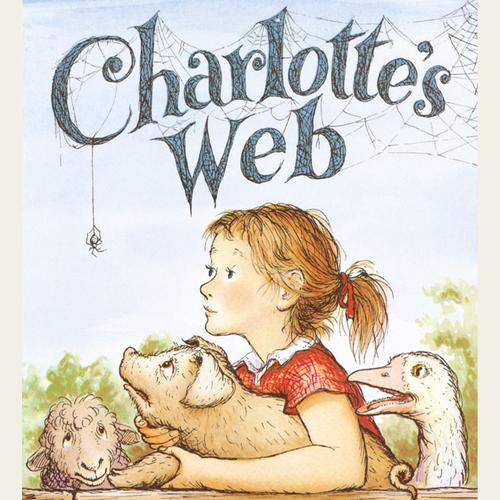
Written in the web: more on Charlotte

It may well be, as I suggested in my last post, that EB White missed a great opportunity to expand children's perspective when he chose to project human emotion onto farm animals, instead of finding ways to introject the very strange "thoughts" of animals into his great children's book, Charlotte's Web. However, reading the book slowly gives us (both children and parents) the opportunity to see some very important things.

The book is almost interesting enough to do a line by line exegesis, but that would bore any reader of this blog silly (even so, it is tempting: consider where I could go with the father's line after Fern convinces him not to kill Wilbur, the runt of the litter: "This morning, Fern went out to right injustice in the world.  She came back with a pig."  Is there a better expression of the life of those of us trying to work for social change, the contrast between the lofty ideals and the hard, often dirty work of the day to day?  But I digress).  Instead, I want to focus on one idea, that Wilbur is a special pig, a particularly noteworthy animal, as he is lauded in his special prize at the fair or by all of his fans who come to the farm.


Truth is, Wilbur isn't at all special.  He's just a pig.  People see him as special because of the work of the invisible Charlotte, who almost literally disappears into the arrow she makes to point at Wilbur.  She begins with the very simple descriptor: "Some Pig."  The message is superfluous: of course Wilbur is some pig.  He is not no pig.  The writing in the web merely points to his existence: there is some pig here!  However, when the hired man Lurvy finds the writing in the web, he is so stunned by the miracle, that he cannot see the words as just a description.  Instead of "some pig [lives here]", the interpretation must be "Some Pig [this is]!"

As Charlotte sees a way to use these words to save Wilbur's life, the writing becomes more and more transparent: she describes Wilbur as "Terrific" and "Radiant" before the final understatement of "Humble."  But once again, the truly amazing character in the story, the one who deserves to be lauded as something truly out of the ordinary, is not Wilbur but Charlotte.  At one point, Mrs. Zuckerman points this fact out, but very quickly the focus of attention returns to Wilbur.

The references to miracles might make us think that something theological is going on, and it might be interesting to walk down that hermeneutic road.  We could see Charlotte as John the Baptist, who appears to have been a much more impressive preacher and political figure than Jesus, but who gets pushed to the back of the official story.  Or maybe mention the Rudolf Bultmann's idea that in Christian thought, we are confused by the fact that the messenger is the message: not anything that Jesus says, but his simple being-in-the-world.

There seems to be an easier interpretation, though, given who EB White was: a journalist.  Journalists write about other people, and those people get the credit and the fame, while the writer fades into the woodwork.  The New Yorker, where White worked, was very clear about effacing the journalist behind the journalism, drawing attention to the message instead of the messenger.

The basic point is what is interesting, though: what makes something special isn't necessarily anything essential to it, but rather what points to it.  Wilbur is a spacial pig, but not because he is really more radiant, more terrific, more clever than any other pig.  Charlotte points to the pig and says he is special, and because of the miraculous capacity of her writing, others come to see Wilbur as special.  When they then treat him as special, he becomes what they want to see in him.  Radiant?  Well, then we wash him in buttermilk, and he becomes radiant.

Kung Fu Panda does something very similar: the great secret to the Dragon scroll is not some esoteric wisdom that will give Po the ability to fight.  It is only a mirror, showing the panda to himself.  "There is no special ingredient in the special ingredient sauce," he reflects (upon finding that there is no magical spice in his father's noodle soup).  "It is special when people believe it is."  With that, Po magically can defeat the great warrior leopard... the story doesn't have as much verisimilitude as Charlotte's Web.

All of this is an empty, if vaguely interesting, interpretation, until we remember that both Charlotte's Web and Kung Fu Panda are directed principally to kids, and only secondarily to intellectual parents looking to find something interesting as they read or watch the stories over and over again.  Kids need to see themselves as special: it's the way that they find themselves in a huge and frightening world.  In a democracy, however, we can't let accept the specialness of aristocrats or kings, and we are reluctant to upset the delicate equality of people.  One solution is that "we are all special," but the son in The Incredibles has an easy response to that: "If everyone is special, then no one is."  Charlotte's Web, and to a lesser degree Kung Fu Panda, offer a more interesting answer to kids' anxiety: you are special because someone loves you, because someone sees you as special.

With that, we have to remember the social practice of reading Charlotte's Web.  My father read it to me.  I read it to Helena.  Though some kids may read the book on their own, mostly it is a family event, something that we do together.  The effort of reading many pages to a child says "I want to put this much effort into being with you.  I like to be with you and tell stories."  Both the message of the book and the messenger (the parent reading it) carry the same meaning to the child: "You are special because I love you."

And with that reflection, I think I understand a bit better why I loved the book so much as a child, and why Helena asked me to start reading ti to her again last night.

Saturday, May 10, 2014

Talking spiders: Charlotte's Web

When I began to write this Children's Media Critic, I wanted to focus on kids movies: I had seen so many parents dismiss these films as simply something to entertain the kids, and I wanted to show that like any work of art, if you look at KidVid carefully, you will learn many unexpected things.  I should remember, though, that books are also a medium of communication, and on a day-to-day level, Helena spends more time reading (or more accurately, listening to) books than she does watching a movie.  So today: Charlotte's Web, which we just finished reading last night.

For those who are a long way form childhood, a quick summary of the novel: Fern, a little girl form a farm, convinces her father not to cull the runt of a pig's litter.  She adopts little Wilbur, feeds him from a baby bottle, and takes him for a walk in a stroller.  Eventually, however, she has to sell him to her uncle, who has a farm big enough to keep the pig.  There, lonely Wilbur meets Charlotte, a gray spider, who writes words about him in her web -- radiant. some pig, humble -- thus winning attention for Wilbur, a win at the county fair, and a stay of execution from becoming bacon.  In the end, Charlotte dies, but several of her many daughters stay with Wilbur on the farm.

Like with any book, the genius is in the details, especially in EB White's elegant prose.  It was only years after my father read me the book that I found out that White was one of the great writers for the New Yorker and enough of an authority on style and grammar that his book was an obligatory reference in high school and college.

Rita, Helena, and I are now working in communities where, like in children's literature, animals and humans communicate.  There is, however, a profound difference between Charlotte's Web (all of the children's literature descending form Aesop, really) and Amazonian Indian thought.  When animals in European and North American children's books talk, we hear the voice of a human being. Wilbur's fears and prides are those of a small child; Charlotte cares for him like a (human) maiden aunt.  The purpose of putting animals in the center of the story is to elucidate human interactions and lessons.

Among Amazonian Indians, however, one tells stories about animals as animals.  You want to get into a jaguar's head because you want to know how he hunts, and so learn from him.  The shaman enters a trance and transforms himself into a caiman in order to understand why it hunts the children from the community.  Like in Charlotte's Web, animals in human stories are there to serve human purposes, but instead of projecting human characteristics onto beasts, the Amazonian narrative projects the beasts' perspective into us.

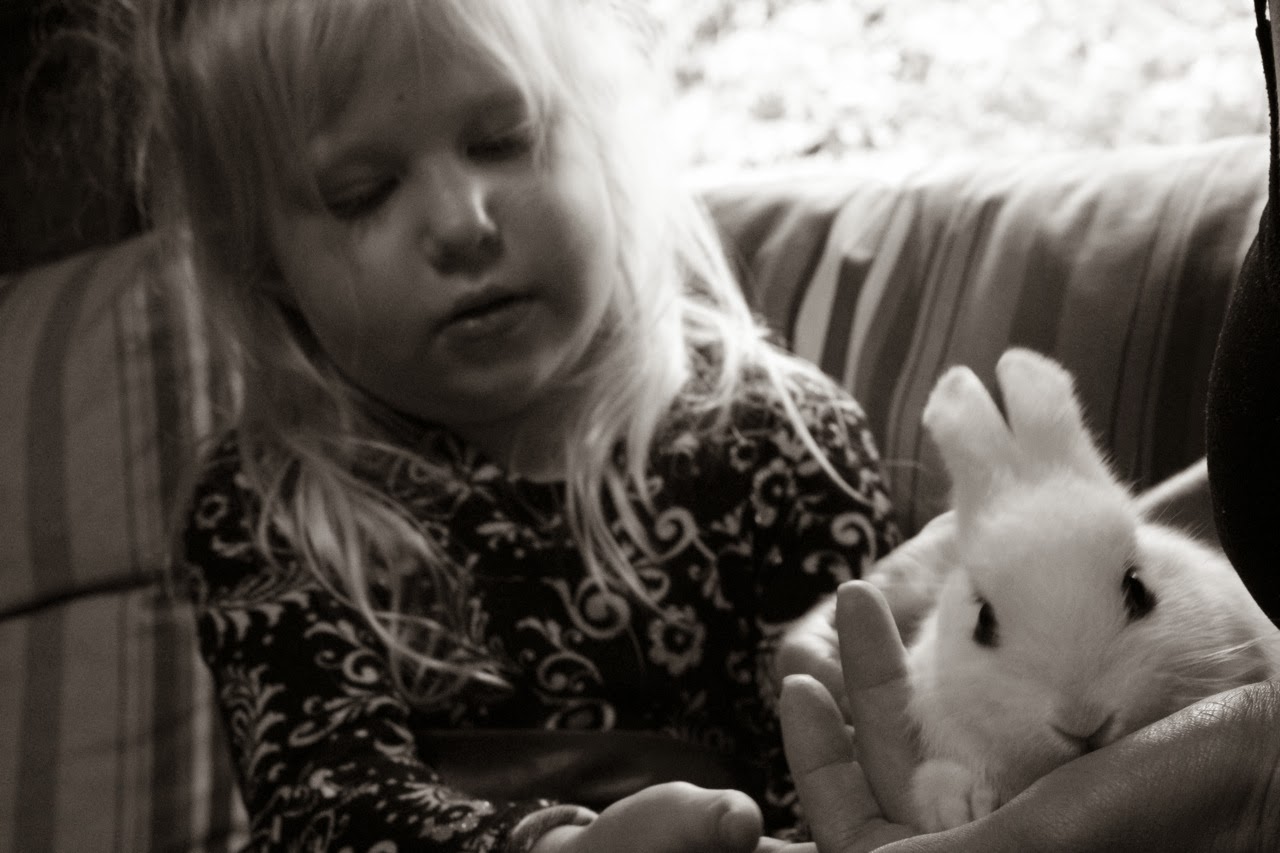
Helena just got a baby rabbit for her birthday, and it has been fascinating to watch her interact with the little creature.  At first, she treated it as a doll.  Then she saw it as her baby.  She is an observant little girl, though, and she has come to see that none of these relations come to terms with the profound otherness of the rabbit, the something else that lies behind the blue eyes of the furry white thing.  Animals have a very different way of seeing the world from people, and I'm sad that European kids stories miss that in their attempt to teach moral or personal lessons.

On the other hand, the freedom to play with ideas that comes with animal stories opens up wonderful possibilities for reflecting about all sorts of things.  Over the next couple of posts, I'll talk about that, more liberating, aspect of Charlotte's Web.

Monday, May 5, 2014

Colonialism and Chaos: The Jungle Book

Helena Iara had her Jungle Book phase about 4 months ago, but over the last couple of days she has been talking about it again, wanting to play at Baloo and Mowgli.  She sings the Bear Necessities, and sometimes asks to see the monkey scene.  As she watched it last night, I began to think about the story symbolically.  Here is the Louie King of the Jungle song, in case you don't remember it:


Before anything else, I think we need to do some symbolic unpacking.  The song is New Orleans Jazz, and the voice sounds like Louie Armstrong. It is actually Louis Prima who sings; Disney first wanted Armstrong to sing, but then was concerned about a black man voicing an ape.  The expedient of changing the race of the singer doesn't really resolve the problem, however, when we see that the movie isn't really abut American racism, but about colonialism.  Rudyard Kipling, who wrote the book upon which the Disney film was based, was the great apologist for the British Empire in India, and the movie actually nods rather honestly in that direction: the elephants, for instance, parody British military virtues.

Let's look at the basic message of the song:

"Now I'm the king of the swingers
Oh, the jungle VIP
I've reached the top and had to stop
And that's what botherin' me
I wanna be a man, mancub
And stroll right into town
And be just like the other men
I'm tired of monkeyin' around!

Oh, oobee doo
I wanna be like you
I wanna walk like you
Talk like you, too
You'll see it's true
An ape like me
Can learn to be human too..."

Here is the basic conceit of colonialism, especially in the "White Man's Burden" form defended by Kipling: the poor, black, deprived "other" in the non-European world wants to be like Europeans.  London is the culmination and apex of what it means to be human, so any way that the Europeans can help these poor deprived people become like Europeans -- even if it means stealing their resources, running their lives, destroying their culture, and even killing them -- is completely right and justified.  Perhaps some jungle kings did want to "walk like [Kipling], talk like [Kipling]," but the truth is that most people would prefer to be in charge of their own lives and make their own decisions.

I should also point out that if the ape wants to be like Kipling, then Kipling (and other beneficiaries of Empire) don't have to think so hard about whether their life is really all that good.  If they want it, well then I'm happy to have it.  (This, by the way, is the essence of the French Feminist Critique of Freud's idea of penis envy, but that's a story for another essay)

Helena, her friend Luc, and her cousin Gabriela.
At first, then, the song looks like an apology for colonialism, white words put into the mouth of the ape/primitive.  As it continues, however, it becomes a much more interesting story.  After all of the dancing and singing, Louie and the apes become aware that Baloo is really a bear, and they try to chase him out of their city.  As they run around and fight with the great bear, they destroy their entire city.  As Baloo and Mowgli flee at the end of the scene, the entire beautiful place falls in on itself, culture turned to rubble.

And what happened with colonialism?  Europeans, unable to see the wealth and depth of African, American, and Asian cultures, didn't care in the least what they destroyed.  Sometimes the destruction was architectural, like in The Jungle Book: think of Cortés in Tenochtitlan or Pizarro in Cuzco.  Other times, it was cultural, as with the British and French in Africa.  But in the end, colonialism knocks it all down.

Even worse, it appears that the apes themselves have destroyed their own city: their act of resistance is what brings the stones down on their own head.  Those who have lived through wars of independence know this situation perfectly: fe years before the Jungle Book was released on screen, we saw the same thing happening in Algeria, as the French blamed the Algerians for destroying their own cities.  

Is the Jungle Book an anti-colonialist screed?  Probably not.  But if we look at it carefully, it does tell the truth -- if in a coded way -- about a nasty episode in world history.

Saturday, May 3, 2014

A film for adults: Shrek 4

I'm not quite sure when the Shrek franchise started to tell the story of my life.  Not in 1 or two, clearly (I haven't rescued many princesses or defeated any evil fairy godmothers), but somewhere in Shrek 3, about the moment when Fiona is yelling out to Shrek on the boat leaving the harbor, the movies began to get too close to home.  Painful, incapacitating anxiety about fatherhood?  Yep, got that one.  Nightmares about vomiting babies?  That too.  And then, Shrek 4.  I'd seen it when it came out, right after Helena was born, but yesterday they had it on TV here in Brazil, and it hit hard.


The plot line is pretty amazingly complex, and I found myself explaining what was going on to Helena and her cousin more than a few times.  Family is great for Shrek... except that all of those good parts repeat and repeat and repeat and repeat, ad nauseum.  (Literally, in fact, given the tendency of the little ogres to throw up on their parents)  Family life, for all of its charm, has become meaningless.  Finally, Shrek explodes at a birthday party: he longs for his old life of adventure and violence, when the villagers would hunt him with pitchforks and he would destroy them with strength and fear.

Been there, done that.  OK, not the nostalgia for violence and pitchforks, but in the first years that Helena was with us, I could only remember the wonder of climbing so high in the Andes that I couldn't breathe, hiding behind concrete walls in Medellín so that bullets wouldn't hit me; lonely nights camping in the jaguar preserves of Central America or hitching across northern Colombia with drug traffickers.  From the outside, why would these sort of things inspire nostalgia?  They seem as miserable as Shrek's lonely life in the swamp.  But that kind of a life breeds stories worth telling.  When you look back, it seems adventuresome and meaningful and special, while the day-to-day pleasures and pains of caring for a child, as wonderful as they are at that moment... they don't make for epic narrative.  The Iliad, as far as I know, includes no scenes of changing diapers.  Or of making faces at a baby and sharing a joyful first laugh.

Shrek thinks he has found a solution, or at least a break, when the evil Rumplestiltskin gives him the chance to go back to his old life in exchange for "one little day, one you don't even remember" of his life.  That day, of course, is the day Shrek was born.  By losing that day, all of history will change, and Rumplestiltskin will be king.  Shrek has to re-conquer Fiona, overcome the evil King... but the more important struggle is to see that "You don't know what you got till it's gone."  Only from the outside, from the perspective of loss, can he see the wonder of his family.  And, in the process, the experience becomes a story, worthy of being told, being filmed, being proud of.

Helena liked the movie.  It's funny, it's well animated.  But the moral of the story isn't for her.  It's for me, and for fathers and mothers like me.  A simple moral, I suppose (even an 80s heavy metal ballad I remember from hight school includes the lyric "You don't know what you got till it's gone" (followed, melodramatically by "Every cowboy sings the same, sad song").  But as a wonderful philosophy professor of mine once told me, "Truth of it is, most important things that philosophers say, everyone already knows them.  Not clever, not worth a huge book and a tenured job.  But we should still say them, again and again."